Pages

November 14, 2011

Wolf Blood (1925)

Shapeshifting, the ability of certain people to transform into an animal has been present in the traditions of almost every culture in the history of humanity. The figure of the werewolf is perhaps the best known example of this fascination, as the mythological lycanthrope has been deeply ingrained in modern popular culture thanks to horror cinema. While vampires, ghosts and witches were well-known figures in Gothic literature before their transition to film, werewolves didn't had more background other than the many different folktales, loosely related between them. This lack of a solid bases resulted in a great freedom to experiment for the writers dealing with the myth of the werewolf, and it would be Curt Siodmak who would define the Werewolf in his seminal script for Universal's classic "The Wolf Man" in 1942. However, that wasn't the first werewolf film, as several movies before tried to make a film about shapeshifters. 1925's "Wolf Blood" is one of the them, an early attempt to bring shapeshifting to film.

In "Wolf Blood" (also known as "Wolfblood: A Tale of the Forest"), George Chesebro plays Dick Bannister, the new field boss of the Ford Logging Company, a lumber camp in the Canadian wilderness trying to compete with the powerful Consolidated Lumber Company. Their rivalry isn't really healthy competition, as Consolidated Lumber Company's aggressive tactics have grown more violent towards the employees of Ford Logging Company, who have even been shot. Bannister requires now the presence of his boss and a medical surgeon to treat his men, but his new boss turns out to be the young Edith Ford (Marguerite Clayton), who arrives with her fiancé, Dr. Gene Horton (Ray Hanford). Bannister falls in love with Miss Ford, but that's probably the least of his problems as he is attacked by rival loggers and left for dead in the woods. Fortunately, he is saved by a transfusion of wolf blood, though this fact begins the rumour that Dick is now a werewolf. Something that he begins to believe, as their rival loggers begin to appear dead. Killed by a savage beast.

Based on a story by Cliff Hill and adapted by prolific scriptwriter Bennett Cohen, the story in "Wolf Blood" has less in common with horror films of the same period and is actually closer to the westerns and adventure films that Cohen was churning out in the 1920s. In fact, other than the novel werewolf theme (which is actually introduced later in the film), the story is basically focused on Bannister's fight against Consolidated Lumber Company, and of course, the love triangle that's established between him, Ford and Dr. Horton. And taken in that way, "Wolf Blood" actually works despite its typical structure and obviously derivative nature. The werewolf aspect of the story, while certainly unexplored, makes for the memorable element of "Wolf Blood": when Dick too begins to believe he's actually a werewolf, the story enters a decidedly darker and more interesting tone. Unfortunately, this is merely a glimpse of what the story could had been if Cohen had been a tad more adventurous in his screenplay, though the ideas are there.

And it's in fact this glimpse what makes for the most remarkable sequence in the film, a visually attractive sequence that begins as soon as Dick begins to hallucinate about his new lupine nature. While the story is the usual fare of adventure and romance, directors Bruce M. Mitchell and George Chesebro at least had a less than typical idea for the film's visual look. With a pretty strong work of cinematography by Lesley Selander (whom later preferred the job of assistant director), "Wolf Blood" captures in a quite vivid manner the world of lumberjacks, in a series of pretty good shots of natural landscapes. And of course, the afore mentioned hallucinatory vision of the ghostly pack of wolves running through the woods is also a pretty remarkable achievement. Given their backgrounds, it's safe to believe that Mitchell was in charge of the visual look, while actor Chesebro handled the actors. Unfortunately, neither Mitchell nor Chesebro manage to take "Wolf Blood" beyond the usual B-movie fare, as the film has a pretty dated narrative style (even for its time).

Given that he was one of the film's directors, it's not surprising that the film's weight is entirely over George Chesebro and his performance as Dick Bannister. Unfortunately, the seasoned veteran of film industry (famous for his roles in Roy Rogers films for Republic) fails to deliver his best work, and is a tad hammy in his performance. Not to say that he is downright bad, but his work is certainly of a pretty average quality. Perhaps the handling of directorial duties was too much for him, as he never directed again and focused on his acting career. A lot better is Marguerite Clayton, who plays Bannister's love interest Edith Ford. As the young socialité, Clayton is actually believable in her role, and as stereotypical as her character is, at least she manages to give her a defined personality. As Dr. Horton, Ray Hanford isn't really amazing, though he does his job competently, albeit it could had been interesting if his character had been better developed.

Despite its clearly supernatural theme, there's little in "Wolf Blood" that would make it qualify as a horror film, as it is heavily grounded in the romance adventure kind of stories that were common in B-movies. Ultimately, this sadly undermines the originality of the film's novel premise, as while the themes are there, it all just feels unexplored, as if the filmmakers had opted to just play safe and go with the proved formula. Which is understandable, given that "Wolf Blood" was by all accounts an independently produced film; however, this doesn't justify the sloppy narrative style that Mitchell and Chesebro employ in the film, as even when compared to the movies done in 1925, "Wolf Blood" can't help but feeling a bit archaic. Granted, it has a couple of remarkably done sequences, but overall the result isn't entirely satisfying, and all in all the film can't help but feeling like a great idea that was left unexploited. Nevertheless, for an early shot at building a story out of werewolves, it probably could had been worse.

While not the first werewolf film (an unfortunately lost film from 1913, Henry MacRae's "The Werewolf" holds that honor), "Wolf Blood" is an interesting early werewolf film that has enough historical importance to be worth a watch. Certainly, it can be a disappointment if one expects a full-fledged horror film, but taken as what it is, a romance adventure with supernatural undertones, it's actually not that bad. A bit mediocre perhaps, but not exactly bad. Overall, "Wolf Blood" makes for an interesting watch if only to witness a quite different take on the werewolf myth, one done before the full moon, before the silver bullet, before Siodmak's classic "The Wolf Man" left its immortal mark in horror history.

5/10
-------------------------------


November 11, 2011

La plus longue nuit du diable (1971)

According to folklore, there were female demons that appeared in dreams, taking the form of a woman in order to seduce men and have sexual intercourse. They were called succubi, or in singular succubus (the male counterpart is called incubus), and supposedly their visits not only represented a big risk of damnation for the soul, but also a rapid deterioration of physical health that could lead to death. With this mix of dangerous evil and sexuality, it was only natural that the myth of the succubus would enter fiction, and can be found in the works of authors ranging from Honoré de Balzac to Orson Scott Card. In film, succubi were naturally suited for the horror genre, and one of the films that explore this concept is an Italian-Belgian co-production from 1971, known in Italian as "La terrificante notte del demonio" and in French as "La plus longue nuit du diable", which could be roughly translated as "The Devil's Longest Night". The film also had several names in English, though the most common is "The Devil's Nightmare".

Also known as "Vampire Playgirls", "La plus longue nuit du diable" is the story of six tourists who travel through the Belgian mountains in a bus driven by Mr. Ducha (Christian Maillet). They find the road blocked and night is coming, but to their fortune, a farmer (Daniel Emilfork) tells them to go to castle Von Rhoneberg, where the Baron will surely allow them to spend the night. The group arrives to the Baron's castle, and to their surprise, they are informed that they were expected, so they enter the castle. Baron Von Rhoneberg (Jean Servais) gets to meet the group of travelers, which is made of young seminarist Alvin Sorel (Jacques Monseau), the old Mr. Mason (Lucien Raimbourg), Howard and Nancy Foster (Lorenzo Terzon and Colette Emmanuelle), and two friends, Corinne (Ivana Novak) and Regine (Shirley Corrigan). An eight guest arrives to the castle, Lisa Müller (Erika Blanc), a young and beautiful woman looking for refuge. However, her presence will trigger strange events related to the Von Rhoneberg curse.

Producer, Pierre-Claude Garnier, along writer Patrice Rohmm, wrote the screenplay for "La plus longue nuit du diable" with the central idea of having each of the guests represent one of the seven deadly sins. The succubus begins to murder the tourists using their vices to entice them and having them to die in mortal sin, so the Devil can collect their souls. A fairly original premise that makes for several interesting situations, as while most of the characters are merely archetypes of their respective sin, Garnier and Rohmm manages to built out of them a group of well defined characters. Particularly interesting is the relationship that's built between the seminarist and Lisa, as the young man begins a battle between his beliefs and his desires. Unfortunately, there's nothing more besides the seven deadly sins concept, as the theme of Von Rhoneberg's curse is only thinly explored, and there is also the odd inclusion of a subplot about a murdered reporter that doesn't go anywhere.

However, if the plot is thin, director Jean Brismée surely makes the most of it, as he makes of "La plus longue nuit du diable" an enormously atmospheric Gothic film of a surreal beauty. Two elements stand out in the film: the remarkable work of cinematography done by André Goeffers and the haunting, ethereal score composed by Alessandro Alessandroni. Giving great use to Goeffers' eye, director Brismée constructs a movie with the logic of a nightmare. Taking full advantage of the beautiful location he had for the film, Brismée conveys a nightmarish atmosphere of dread that give the film an ethereal mood. The dose of eroticism he adds to the film is appropriate, fitting the story's tone without detracting the attention to the horror in the film. In fact, "La plus longue nuit du diable" perfectly conveys that mix of malicious evil and sensuality that the succubi myths evoke. Alessandroni's score is perhaps the film's highlight, as he creates a haunting work of somber beauty, enhanced by the vocal work of his sister Giulia.

The acting is a mixed bag, as while there are some very good performances, others end up being too bland. As Alvin Sorel, Jacques Monseau is appropriate in his portrayal of a doubting young man, torn between the dignity he aims to represent, and his carnal desires. The gorgeous Erika Blanc (of "Operazione paura" fame) plays Lisa, the mysterious young woman who turns out to be the herald of the devil, the succubus. As Lisa, Erika displays her enormous talent to look both seductive and classy, often transmitting more with a simple facial gesture than with her lines. However, this facial expressiveness of her is shown best when her Succubus persona appears, as Erika Blanc manages to fully transform her image from one of great beauty to an horrific representation of Death. Certainly, the decision of having a subtle make-up helps, but it's Blanc who truly elevates the result. The rest of the cast is perhaps less interesting, with the exception of Daniel Emilfork, who's particularly chilling as the Devil himself.

"La plus longue nuit du diable" is a film of extremes, having elements of great quality yet at the same time being particularly weak in several aspects. Perhaps what harms the film the most is the bane of so many films: a poorly developed screenplay. Certainly, the seven deadly sins angle is notable in the way it's explored, and the film really takes off once the tourists begin to meet their demise. However, this happens later in the film, with the first part being not only the tourists' arrival and introduction, but the strange segment about the reporter. This is perhaps the strangest element in the film, as it serves no purpose other than to introduce the VOn Rohneberg curse. Anyways, it's a testament of Jean Brismée's talent how he managed to create such an atmospheric film out of such a thing screenplay. Also, the lack of budget is particularly notorious, as despite its great locations, the film does have pretty cheap special effects that deter from the viewing experience.

Despite its problems, "La plus longue nuit du diable" is a heavily underrated jewel of European horror that deserves to be better remembered. It was Jean Brismée's last film before retiring (he became a teacher at Belgium's Institut national supérieur des arts du spectacle et des techniques de diffusion) and showcases one of the best performances by the beautiful Erika Blanc. Certainly it's not a film that has aged well, but amongst the many horror erotica films done in the 70s, Brismée's take on the succubus myth is a remarkable work of great beauty. It's certainly tame for today's standards, but the important thing about "La plus longue nuit du diable" is its surreal atmosphere. It certainly lives up to its English title of "Devil's Nightmare", as that's the kind of logic the film has.

7/10
-------------------------------

November 10, 2011

L'autre monde (2010)

One of the most interesting new concepts that resulted from the creation of the Internet was that of massively multiplayer online games, that is, games where multiple players use the Internet to enter a computer-simulated world. As technology advanced, the games have become more and more detailed in their depiction of virtual worlds, to the point that games like "Second Life" have even developed its own virtual economy. Certainly, this has also raised concerns about the security and privacy of these virtual worlds, particularly because of the malicious use that could be given to them. This idea of a new brave new virtual world to explore, where one can create an identity completely different than the real one, inspired French director Gilles Marchand (of "Qui a tué Bambi?" fame) to create a story of suspense with the concept of a computer-simulated world as the basis. The result is "L'autre monde", literally "The Other World", a somber neo-noir with certain echoes of David Lynch's "Blue Velvet".

Known in English as "Black Heaven", "L'autre monde" is the story of Gaspard (Grégoire Leprince-Ringuet), a young teenager who one day finds a cellphone in beach. Along his girlfriend Marion (Pauline Etienne), Gaspard reads the text messages in it and discover a strange relationship going on between a man called Dragon (Swann Arlaud) and the phone owner, Audrey (Louise Bourgoin). Full of curiosity, Gaspard and Marion track down Dragon and Audrey, and follow them to the nearby woods, where the couple has decided to commit suicide together. Gaspard and Marion try to save them, but they can only rescue Audrey, however, they chose not to reveal their identity to her. Days after that event, Gaspard grows more and more obsessed with Audrey, specially when he discovers that Dragon and Audrey met in the popular massively multiplayer online game "Black Hole". Gaspard makes an account in "Black Hole" and meets Audrey again, but this will literally take him to another world unknown for him, a world of deceit, lies and death.

With a screenplay written by Marchand himself and Dominik Moll (director of the remarkable thriller "Harry un ami qui vous veut du bien"), "L'autre monde" chronicles Gaspard's obsessive infatuation with Audrey, the story's proverbial femme fatal. Gaspard lives in what by all accounts is a perfect world: he lives in a paradisaical seaside town, has recently moved out of home to live in a flat with his friends, and on top of that has just started a relationship with Marion. However, Audrey represents a different world for him, a dangerous yet captivating world that's new and attractive to him (danger is sexy after all). And the novelty of this world is reflected in Black Hole, the online game she frequents. Marchand and Moll make of "L'autre monde" a tale of Gaspard's loss of innocence, as the world turns out to be a lot bigger than what he, in all his adolescent naiveté, thought it was. Gaspard's descent to darkness, and the use they give to the virtual world concept as a twisted mirror of reality is particularly interesting.

This duality between the worlds, Gaspard's real life and his online ventures are portrayed by director Gilles Marchand's use of computer generated animation. The virtual world of Black Hole is an animated noir nightmare perpetually in night time with a minimalist yet decidedly Art Deco design (as contradictory as that may sound). The animation is fluid and has a certain somber beauty, which contrasts with the one of the natural landscapes Marchard's captures in Gaspard's town. Cinematographer Céline Bozon captures the vibrant colors of summer, taking advantage of the locations to create a very natural visual look. In fact, visually Marchard's "L'autre monde" is a very attractive film, which reflects perfectly the way Gaspard's life changes as he enters Black Hole and begins to have a double life there. Duality is a key aspect in "L'autre monde"'s story, and Marchard handles well the mystery aspects of the film, proving himself a capable director and storyteller. Unfortunately, his skill fails to save the screenplays' worst flaws.

The acting is pretty good for the most part, though some of the younger cast members show their lack of experience in their performances. Leading the cast as Gaspard, Grégoire Leprince-Ringuet is really good as the teenager awaking to a world bigger than him. There's great realism in his performance, as he looks convincingly as both a curious innocent and as a malicious jerk. With the film based entirely around him, Leprince-Ringuet's under a lot of pressure, but manages to carry the film convincingly. As the mysterious and alluring Audrey, Louise Bourgoin is effective, though perhaps less convincing. While definitely a beautiful woman, there's a certain stiffness in her performance that plays against her role as femme fatal. Melvil Poupaud, playing Audrey's overprotective brother Vincent is far more successful, making a convincing portrait of a violent, unpredictable man not so happy with the young Gaspard approaching his sister. Pauline Etienne as Gaspard girlfriend is good, but her role is terribly underdeveloped.

And this is perhaps the greatest problem of what otherwise could had been an awesome neo-noir thriller: it's terribly underdeveloped screenplay. Marchard and Moll have created a fascinating tale of lies and deception that truly gives an interesting use to the concept of a second virtual life. However, there's a certain restrain, an unwillingness to actually take the premise to new grounds that it's all left as a mere cautionary tale about the dangers of spending too much time on the Internet. Something that wouldn't be so tragic if it wasn't for the fact that the film seemed to be aiming for better. In "L'autre monde" Marchard conveys all the necessary ingredients for a thrilling noir story (mystery, eroticism, treachery and darkness), but ends up in an anti-climatic tone that seems to betray everything that the film was achieving. Certainly, a disappointment, as the restrain Moll and Marchard show in the weak way they end the story makes the film feel like a TV movie.

"L'autre monde" has many good things going for it, beginning with the approach Marchard takes to portray the virtual world of Black Hole, and the overall noir atmosphere the movie has. However, the weak finale is certainly a disappointment, as it undermines everything that's built initially. And perhaps the disappointment is bigger given the fact that both Marchard and Moll have proved to be skilled in the construction of thrillers (the previously mentioned "Qui a tué Bambi?" and "Harry un ami qui vous veut du bien" are more than enough proof). All in all, "L'autre monde" or "Black Heaven" isn't really a bad film, it's just nowhere near the level its interesting premise could had been taken.

6/10
-------------------------------

November 09, 2011

Among the Fallen (2011)

The 21st century has seen a rise in the amount of independently produced films made by dedicated cinephiles wishing to take their passion to the next level. The increasing amount of digital film equipment available at the consumer level has helped this cinephiles' desire to become independent filmmakers, as it allows them to obtain better looking results within the scope of their limited resources. The horror genre has been benefited by this, as many of these indie filmmakers decided to begin by making a horror film. It's certainly a genre that suits the needs of an upcoming storyteller, as it has a well-defined set of "rules" and a structure that can blend to any kind of experimentation. However, perhaps the most important reason a young filmmaker has to make an independent horror film is simply that the genre is fascinating. Young director Jay Shatzer certainly seems fascinated by horror in his debut, the micro-budget film "Among the Fallen", a brief (barely 60 minutes) but pretty interesting take on the zombie subgenre.

"Among the Fallen" is the story of Will Ashford (director Jay Shatzer himself), a young writer grieving the recent loss of his young wife Sophia (Erica Shatzer) and their unborn child. Depressed and melancholic, Will decides to go to an isolated cabin in the countryside in order to finish his novel and hopefully, overcome the grief that haunts him. However, what seemed like a peaceful location becomes a nightmarish trap for Will as the cabin is attacked by zombies. To make things worse, Will has several horrible visions that confuses his already unstable state of mind, and ultimately is forced to fight for his life. Tormented by his memories, Will must put himself together and fight the zombies with whatever he can find. However, the writer begins to wonder if all the bizarre events that are happening are real or just another hallucination created by his damaged mind. To find the answer, Will has to fight the monsters, who keep coming for him, and the night has just started.

In "Among the Fallen", Jay Shetzer takes the classic scenario of a horde of zombies attacking a cabin (seen as early as in Romero's landmark "Night of the Living Dead"), and gives it a spin by using the concept as an allegory of coping with grief. Ambiguous and heavily symbolic, Shetzer's story is constructed following the surreal logic of a nightmare. Will's visions begin to blur the line between reality and hallucination, reflecting the descent of his mind into madness. In fact, Shetzer's screenplay could be easily divided in two halves: one dedicated to the slow degeneration of Will's mind, and the other to his battle with the zombies. In this aspect, Shetzer makes of the zombie battle a thanatogical study, with Will literally dealing with his dead people in a quite gruesome manner. Interestingly, the screenplay lacks lines of dialog or narration, a bold movement that works as a double-edged sword for the film, as while it kind of makes it somewhat tedious, it also allows to pay attention to the visuals.

And it's in the visuals where Jay Shetzer's "Among the Fallen" stands out amongst the many independent horror films that are produced. And this is not related to the special effects, but to the gorgeous work of cinematography done in the film (camera by Scott Martin and Kevin Mitchell). With great use of visual composition as well as great knowledge of his digital medium, Shetzer builds up a quite visually attractive film that, unlike what could be expected, resorts to long takes and a slow rhythm to narrate its story instead of the fast editing that's common in modern horror, and surprisingly it works. Giving great use to Martin and Mitchell's camera to capture the oppressively melancholic atmosphere of Will's grief, Jay Shetzer succeeds in crafting a "contemplative zombie film" that truly reflects its thematic ambitions. Certainly, it's not a perfect work of cinematography (lack of budget is more than notorious at times), but Shetzer's visual narrative is easily the highlight of the film.

As an actor, Jay Shatzer is fairly good, considering the whole movie rests over his shoulders. While certainly not a great thespian, Shetzer delivers an effective performance that gets the job done without too much overacting. In fact, his subtle and restrained approach works nicely even when the character finally decides to fight back. This gives his performance a quite natural, realist look that makes for a good contrast with the adventure the character is living. As Will's wife Sophia (who appears in flashbacks through the film), Erica Shatzer is amazingly natural and real in her performance. Certainly, director Shatzer took a realist approach when filming the flashbacks, and it fits nicely within Will's nightmare, as the fragmented pieces of a past reality forever gone. The rest of the cast is effective for a zombie film, and the work done in the make-up department (Pat and Scott Martin) is pretty good for the budget, though certainly nothing amazing.

Slow, calm, and melancholic, "Among the Fallen" is the kind of horror film that resorts more on its ambiguity and its atmosphere to create a mood. While owner of a definite visual style and a marvel of cinematography (clearly Shetzer knew what he wanted and how he wanted it to look), it's hard to ignore the fact that its storyline is pretty thin, which sadly harms the film quite a lot. The use of the zombie film to make a metaphor for coping with grief is a pretty interesting approach, but Shetzer's leave its premise underdeveloped, and the result is a film of great visual beauty that struggles to keep things going. Perhaps, if "Among the Fallen" was shorter, it all would flow seamlessly and Shetzer's debut could find a place amongst the best horror short films of recent time. But as it is, it's a bit too tedious for a short film, and too thin for a feature length film. A bit more of screenplay development would had benefited the film a lot, maybe expanding the role of Sophia or developing further ways to keep the ball rolling.

Despite its shortcomings, Jay Shetzer's "Among the Fallen" is a nice surprise amongst independent horror films, since it's definitely different than the norm for zombie films. With its remarkable visual look and its ominous atmosphere of melancholy (plus welcomed nods to both Romero's films and Raimi's "The Evil Dead"), "Among the Fallen" truly shows that newcomer Jay Shetzer has a lot of passion for the genre and a pretty good understanding of the visual medium, two things that could take him to make greater things after this debut. While at times it gets tedious, "Among the Fallen" is well worth a watch if only to appreciate how Shetzer employs his gorgeous visuals to portray the dark descent to madness of a man tortured by grief.

5/10
-------------------------------

November 08, 2011

The Thing (1982)

In 1951, the sci-fi horror film "The Thing from Another World" was released and became a massive commercial success for producer Howard Hawks, who apparently also directed it (though credit went to Christopher Nyby). The film had a tremendous impact in a young kid named John Carpenter, and it prompted him to pursue filmmaking as a career. After film school, Carpenter earned cult status with two independent films: 1976's "Assault on Precinct 13" and 1978's highly influential horror film "Halloween". Both film had shades of Hawks in their making, the former being a spiritual heir of Hawks "Rio Bravo" and the latter directly referencing "The Thing from Another World" by having the film appearing on a TV screen. After having his third major commercial success with the science-fiction adventure "Escape from New York" (1981), Carpenter was set to enter the world of major studio filmmaking. And the film that would mark his entry would be another direct Hawksian reference: a full-fledged remake of "The Thing from Another World".

Titled simply as "The Thing", the story begins in the winter of 1982, in a U.S. research station located in the remote territories of Antarctica. Suddenly, the members of the American crew notice a Norwegian helicopter coming their way, apparently chasing a Husky dog that runs towards the American base. The helicopter lands, and their pilots, showing sings of insanity, try to kill the dog desperately, accidentally shooting towards the Americans. Unfortunately, both pilots end up killed accidentally, leaving the Americans the task of figuring out what made them to be insane and chase the dog, which soon finds itself at home at the base. Being unable to report the incident, pilot R. J. MacReady (Kurt Russell) and Dr. Copper (Richard Dysart) venture to the Norwegian camp to find out more. To their surprise, they find the base destroyed, and the burned remains of a humanoid corpse with horrid features. Returning to the American camp, they'll Soon they'll discover that the dog the Norwegians were hunting wasn't a normal dog, but a thing from another world.

Adapted by screenwriter Bill Lancaster, this version of "The Thing" is a lot more faithful to its source (John W. Campbell's novella "Who goes there?"), with the monster as a creature able to imitate the crew members (or any living creature), a concept that was blatantly ignored by Hawks' version. This approach makes Carpenter's "The Thing" less a straight remake and more a completely different conception of Campbell's novella. As such, Bill Lancaster's script plays with mystery and suspense with great success, enhancing the sensation of paranoia and unpredictability of the plot with excellent results. Lancaster also builds up a great set of well-defined and complex characters, an instrumental element in the film, as a lot of the tension raised steams from the difficult relationships between the crew members, who trapped inside their camp, begin to distrust each other. Unlike Hawks' version, the film's tone is remarkably bleak and pessimist, as an atmosphere of impending doom begins to surround the crew.

In his seminal slasher "Halloween", John Carpenter placed more emphasis on suspense and atmosphere over gore and shock, and while "The Thing" makes great use of Rob Bottin's remarkable work of special effects, it still could be seen as an evolution of that style. Despite the extensive display of Bottin's work, there is still a greater focus on the ominous atmosphere of isolation, distrust and dread that's imbued in the film. Suspense in fact plays a major role in the film, as paranoia begins to grow within the American camp and everyone is suspect of being the Thing. With the great eye of cinematographer Dean Cundey (Capenter's regular collaborator), director John Carpenter creates a claustrophobic nightmare inside the American camp, which with the storm raging outside, becomes a haunting secluded location through Carpenter's vision. And as written above, the work done by Rob Bottin in the special effects department is simply amazing, a superb work of grotesque and absolute genius.

Since the tensions between the crew members make for a quite important element in the movie, the performances by the cast are instrumental for the success of the film, and in this aspect the cast of "The Thing" is also of great quality. In fact, the performances are so effective that one can almost cut the tension with a knife. Carpenter's regular collaborator Kurt Russel stars as pilot MacReady, a cynical man forced to be the man in charge as the situation gets worse. Wilford Brimley delivers another terrific performance as Dr. Blair, a scientist that goes insane figuring out the Thing's purposes. Brimley conveys perfectly the sense of despair that the whole station is, and in his character's madness is perhaps represented the crumbling of their hope. As the short tempered Childs, Keith David is also pretty good, being essentially MacReady's rival in the crew's leadership. Also of note is David Clennon's performance as Palmer, and Donald Moffat, whom adds a lot of dignity in his role as Captain Garry.

When initially released in 1982, John Carpenter's "The Thing" got a cold reception by both the critics and the audiences. Somber, dark and overtly pessimist, the film was seen as a shockingly grotesque spectacle and ended up overshadowed by Steven Spielberg's "E.T.", which had a quite different and friendlier approach to extraterrestrial beings. Nevertheless, Carpenter's take on "The Thing" stands as a monumental achievement in horror filmmaking, proving to be a nightmarish masterpiece that goes beyond its violence and gore, it's a dark venture into mankind's darkest fear: the fear of the isolation. Not only the crew is geographically isolated, they are suddenly alone amidst a bunch of strangers for, nobody knows who could still be human. In this aspect Carpenter surpasses Hawks, who left the monster as an outsider entity. Carpenter's Thing is astute, evil, and could be anyone in the crew; and as Dr. Blair and Captain Garry crumble demoralized by the Thing's menace, Carpenter makes the point that neither science nor military is enough to face it.

While certainly there are aspects in "The Thing" that haven't aged well, this remarkable film still stands as a wonderfully crafted work that shows the extent of Carpenter's talent as a filmmaker. While probably he'll always be remembered for his landmark classic "Halloween", the level of mastery achieved in "The Thing" makes it perhaps his greatest achievement. One of the most interesting and actually scary horror films of all time, "The Thing" is a perfect example of a remake that puts a different angle to its source and creates a powerful new story out of it. The student surpassing his master. Beyond the horror genre, John Carpenter's "The Thing" is probably one of the finest American films ever made.

10/10
-------------------------------

November 07, 2011

The Thing from Another World (1951)

To most people, the name of John W. Campbell may not exactly ring a bell; however, Campbell was probably one of the most influential persons in the history of American science fiction. As the editor of the legendary "Astounding Stories" magazine, Campbell changed the name to "Astounding Science Fiction", and began to publish new young writers such as Lester del Rey, Robert A. Heinlein and Isaac Asimov; essentially shaping up what later was known as the "Golden Age of Science Fiction". Nevertheless, Campbell wasn't only a skilled hunter of new talents, he was also a prolific writer himself, using both his name and the pseudonym Don A. Stuart. Campbell's novella "Who Goes There?", published in 1938, is perhaps his most famous work, not only because of its literary qualities (it's considered one of the finest American sci-fi novellas of all time) but also because of its film adaptations. The first of this adaptations is the 1951 classic "The Thing from Another World", a movie produced (and perhaps directed) by none other than Howard Hawks.

"The Thing from Another World" begins when a North Pole base, Polar Expedition Six, requests an Air Force resupply crew. Captain Pat Hendry (Kenneth Tobey) is sent to the place, taking amongst his crew a reporter, Ned Scott (Douglas Spencer). As they arrive, they are greeted by Doctor Carrington (Robert Cornthwaite) and Doctor Redding (George Fenneman), whom inform them the reason of their request: a strange flying object crashed near their base, and they need to go and investigate. Pat's crew and the scientist travel to the crash site and discover that what crashed in the ice is actually a flying saucer. While they try to uncover the spaceship, the crew accidentally destroys it with the explosives, however, not everything is lost, as a frozen body is found in the ice nearby. The group excavates the body and take it back to their base, still in the large block of ice. A storm hits the base and leaves them without communication, and the strange being that was found at the crash site, begins to wake up.

Adapted by prolific scriptwriter Charles Lederer (though Ben Hecht and Howard Hawks himself also had uncredited but major participations), "The Thing from Another World" diverts significantly from the novella, and changes the basic nature of the monster. While in Campbell's story the monster was able to imitate humans (providing the suspense and paranoia), in Lederer's screenplay the Thing is an intelligent humanoid being with cellular structure related to vegetation. With this change, the story is less about the monster, and more about the social interactions between the crew and the scientists, particularly on the subject of how to deal with the Thing. On one side, the scientists of Dr. Carrington want to preserve the Thing alive, while Captain Pat Hendry wants to destroy it. Lederer takes the side of the soldiers, reflecting the general distrust of science that was felt after the Hiroshima nuclear bombs, and to a lesser extent, the Cold War paranoia, which was typical of sci-fi horror films of the Atomic Age.

Where "The Thing from Another World" shines is in the classy work of directing it has, which is by all accounts quite Hawksian. Though credited only as producer, there's some weight in the claim that it was Hawks and not Christopher Nyby who directed the film. And even if it wasn't Hawks, at least he had considerable input in Nyby's work. What is true is that "The Thing from Another World" is an action packed horror film that certainly plays the right notes and elevates its subject matter above the typical sci-fi fare. As written above, the tension in the film is entirely based on the friction between the human characters, and to this effects Nyby (or Hawks) put considerable weight in developing them and the difficult relationships between them. While they are essentially the basic archetypes of 50s science fiction (All-American soldier, mad scientist), a good effort is done in fleshing them out, and this is instrumental for the success of the film. Nyby and Hawks manage to make their monster a believable threat, something that most monster movies attempt and sorely miss.

Leading the cast as Captain Patrick Hendry, actor Kenneth Tobey delivers a good, restrained performance as the leader of the soldiers. Carrying the movie with his strong presence and natural charm. Subtle in his approach, there's a certain weight that he gives to his performance that makes his character feel trustworthy. Certainly, Tobey fits the classic 1950s hero role proficiently. Nevertheless, the film's highlight is Robert Cornthwaite, who plays Hendry's nemesis Dr. Carrington. Giving his role a calculated dose of malice, Cornthwaite makes a masterful depiction of a man driven by his obsession (knowledge) to the point of amorality, endangering the lives of everyone else. There's a bit of Melville's Captain Ahab in Cornthwaite's performance, and it's commendable the way he manages to portray his character's intelligence with minimal gestures. Margaret Sheridan plays Carrington's secretary and Hendry's love interest, and while her role is certainly limited, her work is pretty effective.

There's no doubt that "The Thing from Another World" is a classic of its genre, as amongst the countless sci-fi horrors from the 1950s, it has a certain class in its craftsmanship that elevates it above the many "creature features" that were produced in that era. Few horrors from the period manage to influx a premise like this (the vegetable monster) with the amount of gravitas the film has (1954's "Them!" would be another example). But certainly, for all its virtues, "The Thing from Another World" is not a film that has aged well, not only in terms of its technical merits, but also regarding its political ideology, which is clearly a product of its time. The film is fully imbued with the idea of treating any outsider as an enemy, and that military action should have more weight than any scientific approach (Dr.Carrington, embodies all the negative aspects of liberal and scientific views). In a way, it's the diametrical opposite to George A. Romero's 1985 film "Day of the Dead".

30 years after the making of "The Thing from Another World", director John Carpenter directed a remake of the film, more faithful (in plot and tone) to Campbell's classic novella. While this is perhaps a case of a remake proving itself superior to the original, Howard Hawks place as a classic sci-fi horror of Cold War remains unquestioned. While it does have several shortcomings and time hasn't treated it well, its enormous influence over science fiction cinema can still be felt. Though nowadays it's can feel dated and even archaic, Hawks' "The Thing from Another World" can still be an enjoyable film to watch, mainly because if had one element that no very few "creature features" of the same period had: class.

7/10
-------------------------------

November 04, 2011

Eragon (2006)

Once upon a time, there was a young boy named Christopher Paolini, whose favorite hobby was to read fantasy books. Inspired by his favorite books and movies, Paolini decided to write his own fantasy stories, tales about worlds where dragons and magic existed, about the adventures of brave warriors and powerful sorcerers. Thus was the origin of "Eragon", Paolini's first completed book, which he self-published in 2002 with the support of his parents and their small publishing company. The young author got lucky, as the son of author Carl Hiaasen found a copy of this edition of "Eragon" in a bookstore. Hiaasen contacted his publisher and told him about Paolini, and soon the young writer had the chance of taking the story of Eragon to a greater audience. "Eragon", the debut novel became a best seller, and Christopher Paolini became one of the youngest writers in achieve success in fantasy fiction. Naturally, a movie version of the successful novel was the next step. Unfortunately, not everything came out as expected.

Eragon (Edward Speleers) is a young 17 years old teenager, who lives with his uncle Garrow (Alun Armstrong) and his cousin Roran (Christopher Egan) as farmers in the small town of Carvahall, part of the country of of Alagaësia, a fantastic land oppressed by the hand of its ruler, a man named Galbatorix (John Malkovich). After having eliminated his opposition, Galbatorix crowned himself king and rules Algaësia with an iron fist. One day, young Eragon finds a mysterious stone while going hunting, and to his surprise, what he thought was a stone is actually the rarest thing in the world: a dragon's egg. Soon the dragon is born, and Eragon finds himself being chosen by the dragon as her legitimate rider, and destined to be the hope of those who still want a country free of Galbatorix oppressive reign. With the aid of his dragon, Saphira (Rachel Weisz), and the guidance of an old warrior named Brom (Jeremy Irons), Eragon will finally be able to fulfill his dream of being a hero, a legendary Dragon Rider.

Ever since its first publishing as a novel, "Eragon" faced strong criticism due to the somewhat derivative nature of its storyline that more often than not tended to feel more like an imitation of classic works of the fantasy genre (such as "Lord of the Rings" or "Star Wars") than as an original work. Unfortunately, the adaptation to the big screen (by writer Peter Buchman) doesn't do much to deny the validity of those claims, and in fact looks precisely as a typical, clichéd carbon copy of previous (and better) fantasy stories. With major changes to the storyline, Buchman's work simplifies things and leaves "Eragon" void of the juvenile charm that prompted Paolini's novel to the best sellers lists. "Eragon" the novel wasn't a groundbreaking work, though it made for an new take on the classic "hero's journey" pattern; as adapted by Buchman, "Eragon" is a simplistic clone of "Star Wars" (itself perhaps one of the best versions of the "hero's journey" monomyth), lacking any identity of its own.

After having build up a career as visual effects supervisor in Industrial Light & Magic, Stefen Fangmeier debuts as a director in "Eragon", in an effort marred by the poor quality of its screenplay. As expected given his background, Fangmeier creates a visually arresting film, with a good array of great special effects that find their culmination in the realization of dragon Saphira, which in itself it's a remarkable technical achievement. Nevertheless, remarkable special effects aren't everything in a film, and "Eragon" proves again that cinema is all about the storyline, and no matter how good the special effects are, a lousy script tends to result in a lousy movie. Granted, good directing can make the exception, but Fangmeier's effort isn't enough to save the ill fated film, as his tacky narrative results in scenes that look beautiful but add little to the story, and in the end "Eragon" just feels like an incomplete, unfocused work that never reaches its potential.

The cast is another problem in the film, as the young inexperienced actors chosen to play the lead characters deliver a pretty average work that only makes the messy lines of dialog sound even worse than what they already are. Edward Speleers as Eragon is awfully wooden, and while he delivers the right amount of angst his teenage character requires, overall it seems that Speleers got the part based on his looks instead of his talents. Same case is the one of Sienna Guillory, whose bland performance as Arya never really becomes a believable role, looking dull and articial. Among the young cast the only saving grace is Garrett Hedlund as Murtagh, but his screen time is so limited that even when his performance is worthy, his character never goes beyond being a two-dimensional stereotype. Now, the adult cast has slightly better luck, starting with Jeremy Irons, who manages to deliver a dignified performance as Brom, but the highlight is Rachel Weisz as the voice of Saphira. Sadly John Malkovich goes over the top without adding depth to the villain he plays.

Director Stefen Fangmeier's lack of experience directing actors becomes notorious as there's no real balance between the cast's performances. Like other former Visual effects artists, Fangmeier shows great talent directing scenes based on physical actions and purely visual narrative (it's worth to point out that cinematographer Hugh Johnson makes a decent job); however his handling of dialog based scenes is pretty much disastrous. This results in an uneven quality in his storytelling, which feels dull and bland. However, the failure of "Eragon" should not be entirely blamed on the young cast or on its equally unexperienced director, but on the badly written screenplay that takes its storyline through every cliché in the post-Tolkien fantasy fiction. While being a film dealing with wizards and dragons, the film lacks any real sense of wonder, it just falls flat as simply another dull and average fantasy tale that unfolds its story without focus and without direction.

After the renewed interest in fantasy films sparked by the successful adaptations of J. K. Rowling's "Harry Potter" series and Tolkien's "The Lord of the Rings", many other adaptations of fantasy books began to be realized, in the hope of discovering a new successful franchise. Unfortunately for "Eragon"'s fans, Fangmeier's film version of Paolini's book is a quite uninspired film that failed to explore the story's potential. Full of clichés and common places, the screenplay only adds strength to the argument of derivative that Paolini's novel receives. While not entirely awful, "Eragon" is a subpar fantasy film; and the best sign of this is that the best acting in the film is done by an animated dragon.

4/10
-------------------------------
November 02, 2011

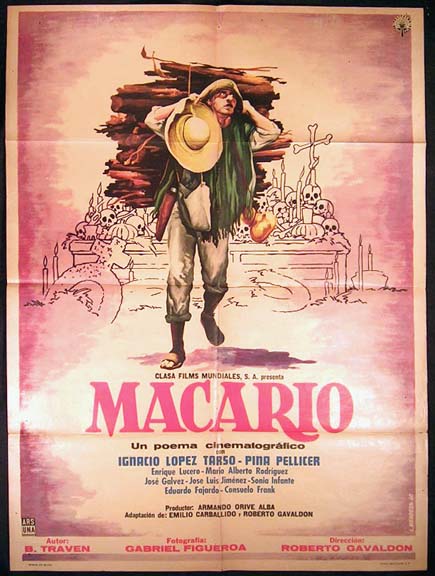
Macario (1960)

Perhaps one of the most amazing figures in modern literature is that of the enigmatic author B. Traven, whom despite having been a successful writer during his lifetime, to this date the details of his life remain unsolved mysteries. Better known for having written the novel "Der Schatz der Sierra Madre" ("The Treasure of the Sierra Madre", basis for John Huston's classic film of the same name), very few is known about the mysterious writer, and even his nationality is a matter of debate (clues point to him being either American or German). What is know for sure is that at certain point in his life, Traven traveled to Mexico and became fascinated with the country's rich culture and natural beauty, as well as with its complex social issues. The novella "Macario" (published in German as "Der Dritte Gast", literally, "The Third Guest", but known in English as "The Healer") is another of his best known works, and the source novel of one of Mexico's most fascinating and beautiful films: Roberto Gavaldón's "Macario".

Macario (Ignacio López Tarso) is a very poor indigenous lumberjack during the Colonial Mexico, whose only dream in life is to be able to eat a roasted turkey all by himself, as he always has had to give up his meals so the rest of his big family can eat. On the eve of Mexican "Day of the Dead" celebration, his wife (Pina Pellicer) steals a turkey and hides it from her kids, as she is decided to make Macario's dream come true. The following morning she gives Macario the turkey for lunch, and the happy lumberjack rushes to the forest to eat it. Deep in the woods with his wife's gift, Macario is about to eat his cherished meal when three strangers ask him to share his food. Macario denies it to the first two, but feels compassion for the third (Enrique Lucero), who later reveals himself as Death. In exchange for the meal, Death gives Macario a water that has the power to cure everything. With Death's gift Macario will become a famous healer who'll receive the attention of the entire region, but also of the Inquisition.

Adapted by writer Emilio Carballido and director Roberto Gavaldón himself, the movie remains relatively faithful to Traven's story (itself an adaptation of the classic German fairy tale "Der Gevatter Tod", or "Godfather Death") and retains the mix of harsh realism and dark fantasy that lays at the core of the short novella. Like Traven's fable, the screenplay of "Macario" is filled with symbolism, enriched by the added details regarding the Mexican culture and the traditional celebration of the Day of the Dead. Not only the film begins during the Day of the Dead celebration, but several parallels are drawn between the Mexican tradition and the film's plot, particularly the personification of Death not as an enemy, but as a companion, as a friend to share a meal with. Traven's usual anti-capitalism can still be felt in Carballido and Gavaldón's screenplay, which several times points out the class difference between the poor family of Macario and the rich house of Don Ramiro, the wealthy landowner played by Mario Alberto Rodríguez.

As usual with Roberto Gavaldón's films, his direction in "Macario" is technically impeccable, though the film also proves that Gavaldón wasn't merely a technically proficient craftsman, but also an interesting and quite accomplished artist, worthy to be considered amongst the greatest directors of Mexican cinema. Like its source novel, "Macario" is heavily symbolic, with the Mexican death-related imagery playing a significant role in building up the powerful atmosphere of dark fantasy the film has (a particularly remarkable scene is Macario's nightmare, which shows an influence of Luis Buñuel's surreal cinema). The film as a whole walks the line between a sense of realism (reflected in the relationships between social classes) and one of full surrealist fantasy, which could make the film to be somewhat related to the magical realism. Legendary cinematographer Gabriel Figueroa makes one of his finest works in this film, capturing breathtaking images of supernatural beauty that enhance the dark atmosphere of Gavaldón's fable.

While Figueroa's photography is truly a highlight of the film, it's worth to point out that the cast also makes a wonderful job in bringing to life the characters of Traven's "Macario". 1960 proved to be an important year in the career of legendary actor Ignacio López Tarso, as he got his first important roles in this movie and in "La Sombra del Caudillo". As the lead character, Macario, López Tarso shows a great natural charm and a strong presence in his role, as well as a great skill for facial expression. While at times his performance feels a bit stagy, in "Macario" he already shows why he later was considered as one of the finest Mexican actors ever. "Macario" was also the first role of Pina Pellicer's and one of her best in her sadly short career (she committed suicide four years later). Her work is so full of realism and is so natural, that conveys a strong emotion despite her limited screen time. Enrique Lucero completes the cast with a haunting, yet charming performance as Death, that appears to Macario as a poor and badly nourished shepherd.

In many of Roberto Gavaldón's films, death and fate play instrumental roles in the story lines, and in "Macario" this is perhaps taken to its most symbolic extreme. But as written above, Death is not an enemy, but an ally for Macario. Not necessarily an evil force, but an element of balance. Macario is just able to twist that balance a little bit, as Death itself is still ruthless, and fate still is unmovable. Interestingly, the clearly defined evil force is actually human, shaped in the envy others feel at watching Macario's success as a healer. Again, Traven's anti-capitalism is present: evil is the all too human feeling of envy. While "Macario" hasn't aged that well (it's special effects for example, are terribly dated), the movie still retains its haunting atmosphere of dark fantasy, an unnatural charm perhaps better defined as "magic", that makes it captivating. The sheer beauty of Figueroa's images, coupled with the marvelous work of acting put together by the hand of Gavaldón result in a powerful and fascinating film.

While "Macario" went on to earn multiple awards across the globe (including an Academy Award nomination for Best Foreign Language film), the film wasn't that well received in country as it was accused of being an artificial and overtly nationalist bait designed to win foreign awards. While the critics of its time may have a point in the film's use of folklore, "Macario" stands as an undeniable achievement of great technique and artistic value. Full of symbolism and owner of an impressive work of cinematography, "Macario" remains as one of Roberto Gavaldón's best films, and one of the last gems of the "Mexican Golden Age", which by 1960 was already in decline. An amazing example of Mexican filmmaking, "Macario" is a definitive classic of the dark fantasy genre.

9/10
-------------------------------

November 01, 2011

El Hombre Bestia (1934)

Despite being a country that quickly adopted cinema as an art form, Argentina's filmmakers weren't too keen of venturing into the fantastic genres, and the themes of Argentine cinema remained based on the country's literary tradition. Comedy and drama derived from theater were the prominent genres of the silent era, and the arrival of sound didn't do much to change this, as it only meant that Argentina's rich musical culture would finally be translated to the screen. However, one man decided that Argentina could also produce fantastic stories, and in the early 30s began to produce what would become as Argentina's first horror film. That man was journalist Camilo Zaccaría Soprani, and the film was titled "El Hombre Bestia", an independent production done without money or talent, but perhaps with lots of passion. The film was presumed lost for almost 70 years, until it was finally found and released again in the year 2002. While it's good to see it again, this may be a case of a film whose historical importance is greater than its artistic value.

The story of "El Homre Bestia" (literally "The Beast Man") begins with Captain Richard (Saverio Yaquinto), a brave pilot during World War I, whom is forced to land in the jungle, crashing his plane. The captain survives, but is unable to return, and uses his survival skills to live in the jungle, when he becomes more and more savage as years go by, eventually transforming Richard into a feral man not too different from Tarzan. Twelve years after his plane crashed, fate plays on Richard's favor and another plane lands in the island. The savage Richard murders the pilot and uses the plane to return to civilization, however, loss of fuel forces him to land in the house of the strange Dr. Marchessi (Raúl D'Angeli). Now, Richard immediately captures the attention of Dr. Marchessi, who becomes interested in his beastly traits and manages to inject an experimental formula in the unsuspecting Richard. The formula transforms Richard into a crazed monster driven by lust, and begins to kidnap beautiful young ladies.

The screenplay, by C. Z. Soprani himself, is basically a collection of the many bizarre adventures that captain Richard endures, from his days as a pilot to his survival in the jungle, and later to his dealing with Dr. Marchessi and the manhunt that the families of the kidnapped girls organize to stop him. In fact, a lot of things happen in the barely 50 minutes of runtime the film has, clearly an indicator of Soprani's desire of creating a tale of action and adventure that had a bit of everything. Unfortunately, it all feels forced and contrived due to the poor organization the story has. And so, the tone and mood of the movie varies in every segment, as it initially begins as a tale of adventure which soon becomes a strange horror film as the story unfolds. In fact, Richard himself goes from being the film's apparent protagonist (the film often bears a subtitle translated as "The Adventures of Captain Richard"), to transform into essentially one of the villains, as Dr. Manchessi's formula makes him even more savage.

Like Carl Theodor Dreyer's classic "Vampyr", Soprani's "El Hombre Bestia" is somewhat of an hybrid of a silent film and talkie, with some scenes having intertitles and texts to follow the plot, while others have the recorded audio of the dialogs. However, unlike Dreyer's surreal tale of vampirism, in Soprani's film this is done without real care, and instead of looking more like a mere budgetary decision than like a purely artistic choice. And looking the film, it seems like budget was behind most of Soprani's directorial decisions, as it seems like many different scenes where done in the same locations, and Soprani shows a taste for borrowing archival footage for the most complicated scenes. Soprani's visual style feels closer to silent cinema than to the kind of filmmaking that was being done in the early 1930s, and the cramming of the many adventures of captain Richard is done without real care or sense of pacing, resulting in a tacky narrative that seems disjointed and even incoherent at times.

Acting in "El Hombre Bestia" is pretty poor, which given the lack of experience of the performers may be understandable. Like the whole visual style of the film, the acting also feels more at home in a silent film, even in the scenes where there's sound. Saverio Yaquinto, who plays captain Richard, isn't really that bad, playing efficiently the stereotype character of the feral man so often seen in many silent films about jungle adventures. Certainly he seems hammy in his role, though in his case this is more likely the result of a pretty poor direction, as his role becomes merely physical, and limited to performing stunts. The real problems begin with the actors not playing a silent feral man, which would mean everyone else, as they are all wooden at best, and atrocious at worst. Raúl D'Angeli, who plays the evil Dr. Marchessi is perhaps the worst offender, delivering a truly uninspired performance. Nevertheless, all things aside, in the end it all comes down to C. Z. Soprani's terrible job as a director.

Certainly, "El Hombre Bestia" is plagued with problems that make its enjoyment somewhat difficult. For starters, it's bizarre plot that includes almost every element from American adventure serials (war scenes, jungle peril, mad scientist, monster on the loose, detectives, and the list goes on) all crammed in about 50 minutes of footage, is something to consider. Without regards for logic or coherence, the story moves from episode to episode moved by weird circumstances that truly defies the strongest suspension of disbelief. Even for its time, it's a great leap to think of "El Hombre Bestia" seriously, which leads to the other problem the film faces: for a 1934 production, it feels more than antiquated, it's certainly archaic. Beyond the fact that its an hybrid of a silent film and a talkie, its plot sounds like something from the early years of silent cinema, where everything was new and unexplored. While certainly its low budget is behind many of its problems, it's not a valid justification for most of the many illogical things that take place in the film.

Probably when Camilo Zaccaría Soprani decided to make "El Hombre Bestia" he hoped it could rival with the popular American serials. It's definitely the style of film he attempts to reproduce in his movie, but sadly his ambitious were way beyond his skills. Still, the passion and love for the genre that Soprani had, can really be felt through its mish mash of outrageously weird scenes. The first horror film made in Argentina, "El Hombre Bestia", failed to find an audience and was quickly lost in time. It would take eight more years until Argentina could release its first masterpiece of horror (Manuel Romero's "Una Luz en la Ventana"). As a historical film, "El Hombre Bestia" is invaluable, as the action/horror film it wanted to be, it's pretty forgettable.

4/10
-------------------------------

October 31, 2011

The Manster (1959)

Ever since first published 1886, Robert Louis Stevenson's popular novel "Strange Case of Dr. Jekyll and Mr Hyde" has served as inspiration for numerous works dealing with the concept of "split personality". Beginning with the 1887 stage play (by Thomas Russell Sullivan), the classic novel has been adapted dozens of times, all with different degrees of faithfulness to the source story. However, perhaps the most interesting versions are those that are not exactly typical adaptations of Stevenson's novel, and instead opt for a different angle that often carries only the splitting of the personality. Examples of this are 1963's screwball comedy "The Nutty Professor" and the comic book "The Hulk". Amongst this kind of versions is a Japanese American co-production realized in 1959 titled "The Manster", a tale of horror and science fiction which has earned a reputation as a schlocky camp classic due to its tacky special effects. However, it also has some pretty interesting elements that elevate it from being the typical monster on the loose story.

In "The Manster", Peter Dynley plays Larry Stanford, an American foreign news correspondent who has spent the last few years working in Japan. Tired of being far from home, there's nothing that Larry would want more than to return to his wife Linda (Jane Hylton), so he is eager to finish what will be his last assignment: an interview with the reclusive scientist Dr. Robert Suzuki (Tetsu Nakamura). Larry travels to the volcano where Suzuki has his laboratory, and soon becomes friends with him. However, what he doesn't know is that Suzuki has found him to be the perfect candidate for his ultimate experiment in evolutionary change. Dr. Suzuki drugs Larry and injects him with his new formula. When the reporter awakes, he doesn't remember anything, and eagerly accepts Suzuki's invitation to spend a week of vacation with him and his beautiful assistant Tara (Terri Zimmern). Vacationing with Suzuki, Larry soon forgets about his wife, and enjoys a life of alcohol and women. However, he is also changing physically, and something horrible is growing in his shoulder.

Written collaboratively by director George P. Breakston and William J. Sheldon, "The Manster" is by all accounts, a pretty much typical horror story of the 1950s. There's the general distrust of science that was common in Atomic Age horror, reflected in the science fiction origin of the monster, and in the person of Dr. Suzuki, who fills the "mad scientist" role. However, there are also certain elements that make it quite atypical for its time. For starters, the frank depiction of sex and violence the story has which, while by no means graphic (at least not for modern standards), it's certainly there: an uncontrolled sexual libido is the first thing that awakes in Larry as his transformation begins. Larry has been, in his words, "a good boy" all the years he has been in Japan, but after meeting Suzuki, he becomes a frequent visitor in brothels, and begins an affair with Tara. And this is related to the other element that sets the film apart from the rest: its "Jekyll and Hyde" theme makes it work as a thinly-veiled allegory of alcoholism.

Directed by George P. Breakston and Kenneth G. Crane, at first sight "The Manster" looks also typical in its execution, which is certainly quite simplistic; however, the directors also make some really good choices. To begin with, there's a real care in its portrayal of the Japanese culture. In "The Manster", it's more than just an exotic location, it adds up to the feeling of isolation and loneliness that the lead character begins to experience (the scene at a Buddhist temple is specially haunting). The sombre black and white photography by cinematographer David Mason is actually pretty good, and actually closer in spirit to film noir; something that's particularly appropriate, as the film deals with themes a bit more lurid than the usual fare. The degeneration of Larry is well-handed, for the most part, and the personality change the character undergoes isn't that far fetched. It's only when the remarkably poor special effects appear on the film when "The Manster" shows why it earned its camp classic reputation.

The acting is just slightly above the average, though for the most part the performances are good. As the lead character, Peter Dyneley makes an acceptable job in his portrayal of Larry Standford. Initially a somewhat stereotypical All-American husband, as Larry descends into his life of debauchery there's a good chance for Dyneley to showcase his talents, and often he does. Certainly he is not a great actor, though within his limitations Dyneley doesn't make a bad job. As Dr. Suzuki, Tetsu Nakamura is pretty mediocre, though his role is certainly the most clichéd in the film. Now, as his assistant Tara, the alluring Terry Zimmern is perhaps the film's highlight. Strangely, Zimmern never did any other film and vanished from the spotlight, so "The Manster" remains a testament of what could had been. The rest of the cast is pretty average, though Jerry Ito shows some passion at playing the typical detective a film like "The Manster" must have. Unfortunately, he receives the worst lines in the film.

And bad lines of dialog is a common flaw in "The Manster", which despite having a particularly original angle to its storyline, can't avoid resorting to common places and clichés in its screenplay. And this includes its ending, which is of a moralist nature, though this is hardly a surprise, considering the overall theme the film has. This double face, on one side a lurid tale full of eroticism, and on the other a moralistic story of the Atomic Age, is certainly fitting for a horror tale about a split personality, though one wonders how much would had helped a better constructed climax. Because the ending does feel unfortunately rushed and somewhat incoherent, a huge contrast to the first half, which chronicles Larry's degeneration with such a great care. It feels so different in tone and pacing that is as if the directors had been forced to do it just to meet the deadline. And of course, the film's great bane: it's incompetent special effects. It's true, "The Manster" can't help but looking awfully schlocky with those cheap make-up effects.

Certainly, it's difficult to talk about "The Manster" without discussing the camp value of its silly effects. It's certainly one of the most notorious aspects of the film, and one of the most unintentionally funny as well. Nevertheless, beyond its trashy visuals, "The Manster" is still a sombre tale. As a metaphor for the destructive effects of alcoholism (or any drug in general) the film makes pretty good points; and as a sci-fi tragedy, the movies does work nicely if one gets past its cheap visual look. More ambitious than its budget allowed it to be, "The Manster" is by no means a great film; however, despite its many obvious flaws, this offbeat "Jekyll and Hyde" tale is certainly worth a watch.

6/10
-------------------------------


Download "The Manster" (1959)