Pages

Showing posts with label 1960s. Show all posts

November 23, 2013

7 Women (1966)


Widely regarded as one of the greatest masters in the history of cinema, American director John Ford left a remarkably rich legacy through his long and prolific career in the movies. While chiefly known as a director of Westerns (a genre to which he contributed several masterpieces such as "Stagecoach", "My Darling Clementine" or "The Searchers", to name a few), John Ford's body of work shows a quite versatile filmmaker, able to tackle very diverse types of stories. Unfortunately, that other side of Ford's oeuvre has left a bit overshadowed by the great success of his classic Westerns, but nonetheless it's an interesting facet that's well worthy of checking out. The perfect example of this is "7 Women", the film that closes John Ford's career as the last feature-length fiction film that he would do in his life (his final work would be a documentary, "Chesty: A Tribute to a Legend" in 1970). Being a movie completely focused on a group of female characters, it would seem that this movie is a tad unusual for the legendary director of Westerns, but the truth is that this is actually the perfect farewell from one of cinema's masters.

Set in Chine, in 1935, "7 Women" deals with the tribulations that are lived by the staff at a Christian mission in a remote region in the north of China. Lead by the strict Ms. Agatha Andrews (Margaret Leighton), the staff consists of Andrew's assistant, Ms. Argent (Mildred Dunnock), professor Charles Pether (Eddie Albert) and his wife Florrie (Betty Field), and last but not least, the young Emma Clark (Sue Lyon). At the mission there's the expectation for the arrival of the new doctor, as the situation in the region is difficult with the rumors of attacks by the notorious bandit Tunga Khan (Mike Mazurki). However, to the shock of everyone at the mission, the new doctor is actually a woman, Dr. Cartwright (Anne Bancroft), and it doesn't take much time before Dr. Cartwright's cynicism and open despise for religion collides with the Ms. Andrews' authoritarian personality. Despite this, Dr. Cartwright will prove to be of great help, having to deal with problems such as Mrs. Pether's advanced pregnancy, and the outburst of plague amongst the mission's population. However, her greatest challenge will come with the arrival of Tunga Khan to the mission.

Written by Janet Green and John McCormick, "7 Women" is an adaptation of a short story titled "Chines Finale", written by Norah Lofts (the story had already been adapted to television as part of the "Alcoa Theatre" TV series in 1960). The core drama in "7 Women" is centered mainly in the conflict between Ms. Andrews and Dr. Cartwright, using the contrast between their strong personalities as the basis to make a study on morality, religion and the relationship between them. While for Ms. Andrews' eyes the ways and behavior of Dr. Cartwright are irreligious and immoral at all accounts, ultimately the actions of the tough newcomer begin to prove themselves far more useful for the mission than the strict discipline preached by Ms. Agatha Andrews. As it can be seen, "7 Women" isn't much of an epic adventure in an exotic land, but an intimate character study where the conflicting personalities of the 7 women of the title are dissected, as when adversity comes knocking to their door, they must learn to collaborate despite their multiple personal differences.

In this his last feature-length film as a director, John Ford shows his masterful skill behind the camera at giving life to Lofts' story with a very appropriate and interesting subtlety. As mentioned before, despite the exotic location in which the story is set, "7 Women" works more as an intense drama of a more intimate variety, so director John Ford adapts his very particular style to really get into the microcosm that the mission represents. Ford leaves aside any attempt at visual flare (though Joseph LaShelle's work as cinematographer is brilliant) in favor of a greater focus in his characters. With an agile visual narrative, Ford portraits the mission's staff with great detail carefully developing their different personalities to the plot's benefit. In the end, Tunga Khan's attack is just another excuse to take to the limit the conflict between Ms. Agatha Andrews and Dr. Cartwright. Certainly, the main conflict was one of great interest for Ford, as even since his earlier classic, "Stagecoach" (1939), he had treated the complex theme of hypocrisy in religion's morality.

Naturally, given that "7 Women" is a film focused entirely on the relationships between the characters, the performances by the cast take a greater degree of relevance for the film's success. Fortunately, the acting in "7 Women" is of a superb quality, starting with Anne Bancroft completely taking over the screen as the witty Dr. D.R. Cartwright. While reportedly Bancroft wasn't the first choice for the role, her work is simply outstanding, managing to capture the complex personality of her character, a woman hardened by the frustration of living in a men's world. Her counterpart, Margaret Leighton, makes a fabulous job as Ms. Agatha Andrews, the strict and devoted leader of the mission. What's interesting about Leighton's performance is that she manages to avoid making of her character a caricature, as she conveys the complex subtleties that make her character human. Young Sue Lyon makes an acceptable job as Emma, who finds herself divided between her loyalty to Ms. Andrews and her admiration to Dr. Cartwright, whom she begins to see a role model (to Ms. Andrew's dismay).

At first sight, it would seem to be strange that director John Ford, whom basically helped to create the iconography of the wild west in his Westerns, would take the job of crafting a movie starring almost entirely women. However, "7 Women" is a film that in its themes is actually closer to John Ford's cinema than what one could thing at first: for starters, as in many of Ford's celebrated classics, "7 Women" deals with the conflict of different personalities forced to be together by the circumstances. Besides, Dr. Cartwright's has a lot in common with Ford's cowboys, being clearly outside the "normal" standards upholder by the proper "civilization". Cartwright is strong, smart and independent, so she means a direct threat to the concept of discipline and submission understood by Andrews (whom by the way, has a lot of sexual repression). The role that plays religion is also interesting, as Ford makes of "7 Women" a criticism to the hypocrisy of an arrogant, holier-than-thou attitude that judges based on moral prejudices instead of in the acts of sacrifice.

Certainly, such conflict was of great importance for Ford (a Catholic), given that "beliefs vs. acts" is a major argument between Protestants and Catholics. Now, "7 Women" isn't a movie absolutely without flaws (the most notorious being the fact that's pretty obvious that the film was shot entirely on a set), nevertheless, said flaws are completely overshadowed by the film's many virtues. Due to its unusual characteristics, "7 Women" is usually forgotten when discussion John Ford's filmography but, given its themes and style, the movie actually summarizes perfectly the totality of the work done by this great filmmaker. Gifted with great visual beauty, and intelligent screenplay and superb performances, "7 Women" closes masterfully the career of the legendary filmmaker. And if there's a doubt about it, one just has to check out the final scene of the movie, which is a farewell equally as beautiful as melancholic. The farewell of a master.

10/10
-------------------------------

November 11, 2012

La residencia (1969)

While in many other national film industries, the horror genre had been previously explored almost since the beginning of cinema, in Spain its development had been almost null, as other than some fantasy experiments by film pioneer Segundo de Chomón and Edgar Neville's 1944 film "La Torre de los Siete Jorobados", there wasn't really a proper horror film made by the Spaniard film industry until the arrival of the 1960s. The main reason for this was the hard censorship that Francisco Franco's government had over filmmakers, but in 1962 several changes began to take place in the industry that opened the door for horror movies. And the two most important persons in this rising genre were the filmmakers Jesús Franco and Narciso Ibáñez Serrador. Born in Uruguay to a family of actors, Ibáñez Serrador began his career in Spain initially on theater, later on television, where he put his taste for horror to work in the legendary TV series "Historias para no dormir". After the huge success of this TV series, Ibáñez Serrador released in 1969 his feature length debut: "La residencia".

Set in 19th century France, "La residencia" (in English "The House that Screamed") is the story of a boarding school for girls directed by the strict Mrs. Fourneau (Lilli Palmer). To the school arrives a new student, Teresa (Cristina Galbó), who soon discovers the secrets hidden by the facade of discipline the school has. One of the students, Irene (Mary Maude), trusted assistant to Mrs. Fourneau, takes a particular interest in Teres, and seeks to torture here and humiliate her every time she can. Mrs. Fourneau herself doesn't miss a chance to violently punish the rebel Catalina (Pauline Challoner). While this takes place, Teresa secretly befriends Luis (John Moulder-Brown), son of Mrs. Fourneau, who lives hidden at the school, as his mother doesn't want him to befriend the young girls of the house. Teresa wishes to leave, not only because of the constant humiliations she suffers, but also because several students have gone missing without a trace in the last days, so fear begins to run rampant through the walls of the house.

Based on a story by Juan Tébar, the screenplay for "La residencia" was written by Narciso Ibáñez Serrador himself (under the name of Luis Peñafiel), whom mixes several classic elements of horror to shape a quite innovative story for Spanish horror. On one hand, the setting on an isolated mansion of 19th century brings back memories of traditional Gothic horror fiction, while the plot line of having Teresa facing the tortures of the sadistic Irene give the story a pretty subversive touch of rebellion against authority. Finally, the main plot of the serial killer on the loose, makes "La residencia" an interesting ancestor of the slasher subgenre. However, the most interesting thing in "La residencia"'s screenplay is the amount of readings its plot can have, as there's not only a thinly veiled criticism to authoritarian regimes (such as the one headed by Francisco Franco), but the way Ibáñez develops his characters includes a risky but quite elegant touch of lesbianism in the relationship between Teresa and Irene.

Elegance is perhaps the best way to define the style that director Narciso Ibáñez Serrador employs in "La residencia", style that gives a greater importance to suspense and tension. With a remarkable work of cinematography by Manuel Berenguer, director Ibáñez Serrador creates a film where the atmosphere of repression is felt in every frame. Taking good advantage to his location, Ibáñez Serrador makes his young characters more like prisoners than students, under the strict rule of Fourneau (and the ruthless enforcement of Irene). The fear felt by the characters towards their oppressive environment, is portrayed by Ibáñez Serrador with great detail, and the perfect example is the knitting lesson sequence, where with a brilliant use of montage, the director manages to show the sexual repression latent in the young ladies. As it can be seen, it's suspense rather than horror what makes the most predominant element in the film, though when the killer finally strikes, Ibáñez Serrador creates several images of great impact (and innovative for its time).

With "La residencia", Ibáñez Serrador was trying to reach an international public, so despite its multinational cast, the film was dubbed to English (a common practice in Eurpean cinema of its time). The dubbing isn't that bad, the great quality of some of the performances can still be felt. The crown jewel of the film is the performance by German actress Lilli Palmer, whom as Mrs. Fourneau makes one of the best works in her entire career. With great dignity and an extraordinary screen presence, Palmer creates a character of such an intensity that truly leaves a powerful impression even when she's not in the screen. Palmer manages to fuse the oppressive Mrs. Fourneau with the ominous atmosphere of her school. Excellent as well is the performance of British actress Mary Maude as Irene, who makes a superb work of acting as Mrs. Fourneau's loyal assistant, abusing her position of power to torture her classmates. In front of such excellent jobs, Cristina Galbó is a tad overshadowed, however, she manages to rise up to the challenge and deliver a terrific job.

Being without a doubt one of the best works in Spanish horror, "La residencia" is a great example of Gothic horror that quite possibly serve as inspiration to Italian filmmaker Dario Argento to make "Suspiria" (which is also set at a boarding school). Innovative, captivating and full of suspense, "La residencia" rests on the great care that director Narciso Ibáñez Serrador put in its making. However, despite its many virtues, there are some details that can't be totally forgotten. Perhaps the most obvious one is the complete abandonment of some of the film's most interesting subplots (specially one referring to Catalina), which end up unresolved in favor of the main plot. This is probably the result of a screenplay where Ibáñez Serrador tried to include multiple ideas that in the end had to be sacrificed. Another detail is that perhaps the identity of the killer is a bit too predictable, though it's worth to point out that this doesn't diminish the climax's impact, which is enhanced by a remarkable camera-work and the superb work of Lilli Palmer.

Despite its flaws, "La residencia" is a major work of Spanish horror, and a clear example of the great talent of director Narciso Ibáñez Serrador (talent that would shine again in his 1976's classic "¿Quién puede matar a un niño?"). With its beautiful cinematography and the haunting musical score by Waldo de los Ríos, "La residencia" is a film that, like the best Gothic horror stories, employs the conventions of its genre to make a subtle and elegant portrait of sexual repression. While the film had a pretty cold reception upon its release (in both Spain and in foreign markets), "La residencia" is a film a lot more intelligent that what would seem at first sight, because behind its plot of a serial killer is hidden a harsh criticism to oppressive regimes and their followers. A true forgotten classic of horror cinema.

9/10
-------------------------------
May 21, 2012

Spalovac mrtvol (1969)

Conceived within the walls of the Film and TV School of the Academy of Performing Arts in Prague (FAMU) in the early 1960s, the Czechoslovak New Wave was an important artistic movement that brought light to the artistic sensitivities of a new generation of filmmakers from the communist country. A generation that included amongst its ranks Miloš Forman, Jirí Menzel and Jaromil Jireš, directors that would later become the major figures of Czechoslovak film industry. However, there were also filmmakers who, while less famous, had an equally interesting contribution to the movement, and one of them is Juraj Herz. The reason behind the apparent exclusion of his name from the more famous poster children of the Czechoslovak New Wave is simple: he wasn't a film student, but a theatre student, specifically a puppeteer. However, this puppeteer would bring one of the most interesting styles amongst the movement, one grounded in the horrific and the grotesque, and "Spalovac mrtvol", "The Cremator", is perhaps the best example of it.

Set at the onset of the occupation by Nazi Germany, "Spalovac mrtvol" tells the story of Karl Kopfrkingl (Rudolf Hrusínský), the man in charge of a crematorium in Prague. While friendly and sociable, Karl has a morbid fascination with the dead which he fuels with his reading of the Tibetan Book of the Dead. To Karl, the cremating of a body is necessary for the correct liberation of the soul. Nevertheless, despite the morbidity of his obsessions, Karl remains a loving father to his children Zina (Jana Stehnová) and Mili (Milos Vognic); and though he is attracted to other women, he keeps a cordial albeit distant relationship with his wife Lakmé (Vlasta Chramostová). Karl feels his life is in correct balance, however, when the Nazi forces enter the Czech border, he is invited to join the Nazi party because of his German heritage. The Nazi agents will play with his obsessions, awaking the manias that Karl has hidden in the deepest side of his soul.

"Spalovac mrtvol" was based on the novel by Czech author Ladislav Fuks, whose entire oeuvre revolves around German occupation of Czechoslovakia. The screenplay was adapted by Fuks himself along director Juraj Herz, whom use the story of the deranged cremator to make an allegory of the progressive introduction of Nazi ideologies into Czechoslovakia's society. Taking advantage of Karl Kopfrkingl's ambitions and delusions of grandeur, the Nazi influence completes the transformation that makes this morbid yet harmless man to turn his darkest fantasies into a reality. So, driven by his new beliefs, Kopfrkingl is now able to turn against his friends and family, fully convinced that his actions are actually for "the greater good". And what's perhaps more interesting about "Spalovac mrtvol" is that this dark, disturbing tale of psychological horror is told with a great dose of black humor that oddly, gives the film a quite fitting touch of irony.

However, the most striking feature of "Spalovac mrtvol" is its visual narrative, which director Juraj Herz conceived as a highly stylized Gothic nightmare in which disorientation is the key. A disorientation devised to reflect the twisted mind of the film's main character, whose train of thought twists and turns from the morbidly macabre to the downright grotesque. And to do this, Herz makes good use of the lavishly beautiful expressionist cinematography by Stanislav Milota and the frenetic work of editing by Jaromír Janácek. Jump cuts, montages, and a narrative that shifts from linear to non-linear, are some of the tools Herz employs to disorientate, but rather than being clichéd, they feel appropriately in tone with the story. Cinematographer Milota nicely employs the distortion of fish-eye lenses to evoke the distorted vision that Karl has of life, and by playing with light and shadows, Milota creates an unsettling Gothic atmosphere that suits nicely the quirky tone of the film.

As the title character, actor Rudolf Hrusínský shines in the role of Karl Kopfrkingl, the cremator whose twisted desires will take him to a descent to madness. While in a way Karl could be seen as an exaggerated caricature of a madman, Rudolf Hrusínský's remarkable performance gives uncovers the many layers the character has and unveils a complex and somewhat tragic figure. With great use of subtle yet noticeable mannerisms and his powerful screen presence, Hrusínský completely becomes this deranged individual, able to be sympathetic and horrifying at the same time. Certainly, in many ways "Spalovac mrtvol" is entirely Hrusínský's show, however, while the supporting actors in the film do have a considerably inferior space to develop their roles(after all, the film is told from Karl's perspective), some of them truly make an effective job, particularly Vlasta Chramostová, who plays Karl's dutiful and timid wife Lakmé.

Perhaps the most disturbing horror amongst the many conjured by Juraj Herz' "Spalovac mrtvol" is the very fact that while this is an exaggerated tale, it may actually have happened in a way. As the film starts, Karl knows and respects many people who are Jews, however, after the Nazi ideology enters his mindset, the morbid cremator is unable to conciliate those thoughts and begins to see them in a bad light. Behind the horrors unleashed by the deranged Karl himself, the real horror of how the Nazi ideology slowly infiltrated and changed a society's mindset is the most haunting element in "Spalovac mrtvol". In Herz' nightmarish Gothic world, the morbid cremator is certainly a monster, but greater monsters are those playing with his mind. Karl is convinced that his actions are helping a good cause, that he is cleaning the contaminated souls of the world, helping them to achieve peace. Karl's actions are a reminder that the path to hell is paved with good intentions.

While his membership of the Czechoslovak New Wave is often disregarded, the work of director Juraj Herz has many of the trademarks of the movement, though his perspective is often a more perverse and cynical one, and "Spalovac mrtvol" is perhaps the best example of it. Unnerving and grotesque, yet at the same time absurd and darkly comic, "Spalovac mrtvol" or "The Cremator", is a unique gem of Czechoslovak cinema that employs the horror genre to bring light to the real horrors of Nazi occupation. Though more than being an accusatory film, "Spalovac mrtvol" is instead a cathartic one, a film that through its grotesque imagery may help to understand a madness that turned a country against itself.

8/10
-------------------------------

February 13, 2012

Efpeum (1965)

The decade of the 1960s was a decade of many social changes across the globe, as a new generation was rising to find its place in history. Inevitably, such changes would be reflected in the arts, and in the case of cinema, in many places it meant the closure of an era, such as the decline of the American studio system or the end of the so-called Mexican "Golden Age". But it also meant the beginning of a new one. A renewal of ideas of sorts, reflected in the New Hollywood and the French Nouvelle Vague. In the South American country of Venezuela it meant the arrival of a new generation of filmmakers eager to break with the realist tradition of Venezuelan cinema. Amongst this new generation of filmmakers was Mauricio Odremán, a writer who had been working at several production companies and whose first produced screenplay was the 1964 film "Isla de Sal". Deeply interested in surrealism and metaphysics, Odremán reflected his ideas in a short film written and directed by him: Venezuela's first science fiction movie, "Efpeum".

"Efpeum", which actually stands for "Estructura Funcional para Encontrarse uno Mismo" (literally, "Functional Structure to Find Oneself"), begins at the University, where an Architect (Samuel Roldán) is giving a lecture about his new idea: a building, or better said, a structure that more than serving as a housing project could actually help its inhabitants to transcend this dimension. The audience explodes in laughter and the Architect is humiliated and leaves the University. He wanders around, until he is told that there's a man who can help him, an Alchemist (Carlos Guerrero). The Architect meets the Alchemist and explains his project, and proposes him to combine their knowledge in order to create EFPEUM. The Alchemist agrees somewhat reluctantly, and the two begin their work. The two of them have differences, but soon the Architect begins to learn the way of the Alchemist, who begins to consider the Architect as his equal. The arrival of the Alchemist's partner Andreina (Bertha Mantilla) will make them become one.

As can be imagined by the plot, Mauricio Odremán (who wrote the screenplay) uses the conceptions of science fiction in "Efpeum" as the way to express his metaphysical and philosophical beliefs. Basically, "Efpeum" is to the science fiction genre what Jodorowsky's "El Topo" is to the Western. In fact, while in terms of style there is no apparent influence from the Chilean filmmaker, thematically Odremán's "Efpeum" covers topics that are pretty similar to the ones explored by the director of "The Holy Mountain". In "Efpeum", Odremán implies the search for a higher state of mind, and represents two viewpoints in the film's two main characters. The Architect, symbol of reason, pursues knowledge and has the willpower to achieve the project, though his view is narrow due to what society has taught to him. The Alchemist, represents a knowledge closer to nature, a freedom the Architect lacks. However, both are needed to transcend, and the catalyst for this is the female figure, Andreina, and in sexual union the three of them become one.

Visually, Mauricio Odremán's film is a very symbolic work, in which the imagery captured by cinematographer Tony Rodríguez is of a quite allegoric nature. The world of Odremán is a desolated land, in which the human figures seem to be alone looking for meaning, while the University has an oppressive architecture, reminiscent of the German Expressionist style. In his vision of future, Odremán contrasts nature and science, echoing the themes of his screenplay, and this duality is played through the film in its many different set pieces. The narrative is disjointed, though not incoherent, and it follows several stages in the relationship between the Architect and the Alchemist as EFPEUM is being constructed and Andreina appears in their lives. Through the film, Odremán uses sound in pretty interesting and strange ways, aiming to disconcert and disturb in some way. However, the most bizarre of this is his use of romantic ballads to narrate passages of the story (for example, a love song to EFPEUM opens the film), which is quite odd to say the least.

The performances by the cast are a bit stagy, though given the allegorical nature of "EFPEUM", it's probably meant to be this way. Still, it's perhaps the film's weakest element, as the work is unfortunately of a mediocre quality. The only saving grace is Samuel Roldán, who plays the Architect, carrying the story with a natural charm and a certain dignity that makes the outlandish film a tad more believable. Sadly, it can't be said the same about fellow cast-members Carlos Guerrero and Bertha Mantilla. Guerrero, who plays the Alchemist, is too hammy in his role, and even given the nature of the film his work looks out of place. As the mystic Alchemist, Guerrero unfortunately makes more a parody of his role and diminishes the power of the film. However, even worse is Bertha Mantillo, who plays the Alchemist's partner Andreina. While Andreina is meant to represent the sensuous being, an unleashed magic in pure form, her performance is too wooden to be taken seriously, and sadly feels more like a robot than like the wild force of nature she should be.

As can be seen by now, Mauricio Odremán's "Efpeum" is not exactly the typical science fiction tale, it's more a full expression of its maker's metaphysical ideas. An allegoric exploration of themes in which the message between lines is far more important than the actual story. As written above, given its surreal take on philosophical themes, the cinema of Alejandro Jodorowsky could be a considered a close relative to Odremán's film, and as such, this 30 minutes short film is equally as cryptic. However, "Efpeum" suffers of several problems that somewhat difficult its enjoyment. Not only the afore mentioned low quality of the performances is off putting, what's perhaps the greatest problem in Odremán's film is how badly it has aged. And this is not about any technical issue, but about Odremán's abuse of distorted pop culture elements, particularly his use of very 60s romantic ballads, which with time has stopped from being daring or avant-garde and has become pure kitsch.

Certainly a product of its time, "Efpeum" belongs to the most reactionary style of filmmaking of the 1960s. Completely beyond of any classification (certainly, the science fiction genre is only the one that seems to describe it best), Mauricio Odremán's film is one that despite not having aged that well, still can be a fascinating glimpse to the mind of its maker and the topics that interested him. Of great historical importance, this first Venezuelan science fiction film can be difficult to appreciate given its allegorical nature and crude style, though it's still a fascinating example of Latin American surrealism.

6/10
-------------------------------


January 04, 2012

Muerte al invasor (1961)

In 1961, a CIA-trained group of Cuban exiles launched an attempt to overthrow the recently formed Cuban government of Fidel Castro. The operation, codenamed operation Zapata, was supported by the US government and involved landing the beaches of Bahía de Cochinos (Bay of Pigs), east of the Zapata peninsula in Cuba. The invasion was unsuccessful, as the Cuban armed forces defeated the invaders within three days. The failed invasion had as main consequence a much stronger nationalism and greater support for Castro's government in Cuba. This conflict later became known in Cuba as The Battle of Playa Girón (Battle of Girón beach), and in the US as the Bay of Pigs Invasion. Given the great importance that Cuban government gave to cinema, the Instituto Cubano del Arte y la Industria Cinematográphicos (ICAIC) sent a team of war correspondents to cover the event. Amongst them was Tomás Gutiérrez Alea, who constructed a short documentary film about the invasion for the ICAIC's newsreel of Santiago Álvarez: "Muerte al Invasor".

"Muerte al Invasor" (literally "Death to the Invader") is composed of the images captured by Gutiérrez Alea and his team of cameramen: Mario Ferrer, Pablo Martínez and Julio Simoneau. The narration, quite probably written by ICAIC director Alfredo Guevara and voiced by Julio Batista, details the events of the invasion, chronicling the three days of battle while at the same time glorifying the efforts of the Cuban people and its leaders. Given its nature as a documentary meant for a newsreel, its propagandistic goal is more than evident, with the defeated invaders constantly labeled as traitors and oppressors from previous government. The US support to the invaders is also a point discussed extensively in the film, noting the US' effort to overthrow the Cuban socialist government, and describing the covert nature of the operation as an example of imperialist treachery. In fact the film's subtitle describes the invasion as an imperialist aggression. "Muerte al Invasor" is certainly a film with an agenda, so subtlety is not one of its assets.

There has been much debate about who was actually behind the creation of "Muerte al Invasor", with supporters from both Tomás Gutiérrez Alea and Santiago Álvarez claiming sole credit for the film. The film does show early signs of both directors' styles: traces of Álvarez' innovative "nervous montage" can be felt through the film, while on the other side, the images that make up the documentary have the distinguished style of Gutiérrez Alea. And speaking of the images, the images captured on the film are not only of great historical interest, there is a certain raw beauty in some of them that truly portray the spirit of a nation defending itself. Forgetting the jingoistic narration and without taking a political side, those images speak a lot about a young nation that still believed in an ideal, and fought for it. The eloquence of the images in "Muerte al Invasor" give ground to the argument for Gutiérrez Alea as the sole director, but in the end, this newsreel piece may have as much contribution from him, as from Álvarez and even Guevara.

As written above, "Muerte al Invasor" was clearly conceived as a propaganda piece, with its latent glorification of the Cuban nation and its relentless demonization of the imperialist invaders. And this is perhaps the weakest side of the film, as despite the power of its images, the narrative is slow and even dull. Narrator Julio Batista's lack of emotion doesn't help to this, as he remains calm and monotone in his speech, akin to the narrator of a science documentary. As a propaganda piece, it does fulfill its purpose, but it somewhat lacks the vibrant energy of Soviet or posterior Cuban propagandistic cinema. The film's true strength, is clearly in its images and montage, which showcases the talents of its makers and offers a glimpse to their posterior careers. The contrast in quality between the images on film and the written narration is so big that the film could easily work better without the narration. The eye of the young Cuban cinema was enough to tell the story of their victory, no need for added glorification.

"Muerte al Invasor" may not be the best example of the cinema of Tomás Gutiérrez Alea and Santiago Álvarez, though it's certainly a quite interesting film to watch to notice the development that took place for both two filmmakers, later celebrated stars of the Golden Age of Cuban cinema. In a film like "Muerte al Invasor", which clearly has its defined goal and political agenda, it's always difficult to separate the politics from the film, but in this case, whether one agrees or not with its arguments, one thing is clear: with their images and montage, filmmakers Tomás Gutiérrez Alea and Santiago Álvarez have truly captured the face and spirit of a young nation finding itself.

6/10
-------------------------------

November 02, 2011

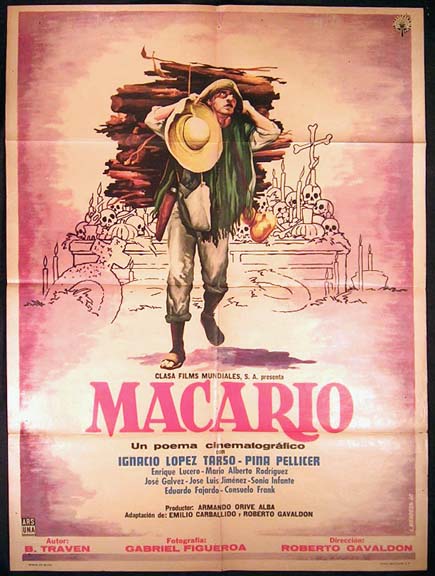
Macario (1960)

Perhaps one of the most amazing figures in modern literature is that of the enigmatic author B. Traven, whom despite having been a successful writer during his lifetime, to this date the details of his life remain unsolved mysteries. Better known for having written the novel "Der Schatz der Sierra Madre" ("The Treasure of the Sierra Madre", basis for John Huston's classic film of the same name), very few is known about the mysterious writer, and even his nationality is a matter of debate (clues point to him being either American or German). What is know for sure is that at certain point in his life, Traven traveled to Mexico and became fascinated with the country's rich culture and natural beauty, as well as with its complex social issues. The novella "Macario" (published in German as "Der Dritte Gast", literally, "The Third Guest", but known in English as "The Healer") is another of his best known works, and the source novel of one of Mexico's most fascinating and beautiful films: Roberto Gavaldón's "Macario".

Macario (Ignacio López Tarso) is a very poor indigenous lumberjack during the Colonial Mexico, whose only dream in life is to be able to eat a roasted turkey all by himself, as he always has had to give up his meals so the rest of his big family can eat. On the eve of Mexican "Day of the Dead" celebration, his wife (Pina Pellicer) steals a turkey and hides it from her kids, as she is decided to make Macario's dream come true. The following morning she gives Macario the turkey for lunch, and the happy lumberjack rushes to the forest to eat it. Deep in the woods with his wife's gift, Macario is about to eat his cherished meal when three strangers ask him to share his food. Macario denies it to the first two, but feels compassion for the third (Enrique Lucero), who later reveals himself as Death. In exchange for the meal, Death gives Macario a water that has the power to cure everything. With Death's gift Macario will become a famous healer who'll receive the attention of the entire region, but also of the Inquisition.

Adapted by writer Emilio Carballido and director Roberto Gavaldón himself, the movie remains relatively faithful to Traven's story (itself an adaptation of the classic German fairy tale "Der Gevatter Tod", or "Godfather Death") and retains the mix of harsh realism and dark fantasy that lays at the core of the short novella. Like Traven's fable, the screenplay of "Macario" is filled with symbolism, enriched by the added details regarding the Mexican culture and the traditional celebration of the Day of the Dead. Not only the film begins during the Day of the Dead celebration, but several parallels are drawn between the Mexican tradition and the film's plot, particularly the personification of Death not as an enemy, but as a companion, as a friend to share a meal with. Traven's usual anti-capitalism can still be felt in Carballido and Gavaldón's screenplay, which several times points out the class difference between the poor family of Macario and the rich house of Don Ramiro, the wealthy landowner played by Mario Alberto Rodríguez.

As usual with Roberto Gavaldón's films, his direction in "Macario" is technically impeccable, though the film also proves that Gavaldón wasn't merely a technically proficient craftsman, but also an interesting and quite accomplished artist, worthy to be considered amongst the greatest directors of Mexican cinema. Like its source novel, "Macario" is heavily symbolic, with the Mexican death-related imagery playing a significant role in building up the powerful atmosphere of dark fantasy the film has (a particularly remarkable scene is Macario's nightmare, which shows an influence of Luis Buñuel's surreal cinema). The film as a whole walks the line between a sense of realism (reflected in the relationships between social classes) and one of full surrealist fantasy, which could make the film to be somewhat related to the magical realism. Legendary cinematographer Gabriel Figueroa makes one of his finest works in this film, capturing breathtaking images of supernatural beauty that enhance the dark atmosphere of Gavaldón's fable.

While Figueroa's photography is truly a highlight of the film, it's worth to point out that the cast also makes a wonderful job in bringing to life the characters of Traven's "Macario". 1960 proved to be an important year in the career of legendary actor Ignacio López Tarso, as he got his first important roles in this movie and in "La Sombra del Caudillo". As the lead character, Macario, López Tarso shows a great natural charm and a strong presence in his role, as well as a great skill for facial expression. While at times his performance feels a bit stagy, in "Macario" he already shows why he later was considered as one of the finest Mexican actors ever. "Macario" was also the first role of Pina Pellicer's and one of her best in her sadly short career (she committed suicide four years later). Her work is so full of realism and is so natural, that conveys a strong emotion despite her limited screen time. Enrique Lucero completes the cast with a haunting, yet charming performance as Death, that appears to Macario as a poor and badly nourished shepherd.

In many of Roberto Gavaldón's films, death and fate play instrumental roles in the story lines, and in "Macario" this is perhaps taken to its most symbolic extreme. But as written above, Death is not an enemy, but an ally for Macario. Not necessarily an evil force, but an element of balance. Macario is just able to twist that balance a little bit, as Death itself is still ruthless, and fate still is unmovable. Interestingly, the clearly defined evil force is actually human, shaped in the envy others feel at watching Macario's success as a healer. Again, Traven's anti-capitalism is present: evil is the all too human feeling of envy. While "Macario" hasn't aged that well (it's special effects for example, are terribly dated), the movie still retains its haunting atmosphere of dark fantasy, an unnatural charm perhaps better defined as "magic", that makes it captivating. The sheer beauty of Figueroa's images, coupled with the marvelous work of acting put together by the hand of Gavaldón result in a powerful and fascinating film.

While "Macario" went on to earn multiple awards across the globe (including an Academy Award nomination for Best Foreign Language film), the film wasn't that well received in country as it was accused of being an artificial and overtly nationalist bait designed to win foreign awards. While the critics of its time may have a point in the film's use of folklore, "Macario" stands as an undeniable achievement of great technique and artistic value. Full of symbolism and owner of an impressive work of cinematography, "Macario" remains as one of Roberto Gavaldón's best films, and one of the last gems of the "Mexican Golden Age", which by 1960 was already in decline. An amazing example of Mexican filmmaking, "Macario" is a definitive classic of the dark fantasy genre.

9/10
-------------------------------

October 28, 2011

Santo en El tesoro de Drácula (1969)

It's probable that when the young wrestler Rodolfo Guzmán took the name of "Santo" in 1942, he never imagined that he would become one of the greatest icons of Mexican cinema. As his popularity in the ring rose, Santo soon got offers to make films, and it would be in the silver screen where the masked wrestler would face his most bizarre foes. Vampires, international criminals, mad scientists and even aliens would be the sort of enemies that movie star Santo would have to defeat. Count Dracula himself challenges Santo in one of his most famous films, 1969's "Santo en El tesoro de Drácula", however, the film's cult status is due to the fact that there was a rumour of an alternative cut, one that added scenes of Dracula's harem of nude vampires. Titled "El Vampiro y el Sexo", this version was lost for years and its existence was source of constant debate amongst fans; until 2010, when the missing cut was finally found. Unfortunately, the discovery of the legendary lost version allows to find even more shortcomings in "Santo en El tesoro de Drácula".

In this adventure, Santo is not only a successful wrestler, but also a talented scientist, and with the help of his friend and colleague Dr. Sepúlveda (Carlos Agosti), Santo has made an astounding discovery in his research. Dr. Sepúlveda invites other scientists to his house, in order to hear about Santo's invention: a machine that allows its user to "experience" a past life. Naturally, the group demands proof of this theory, but Santo has not tested his machine with a human yet. Defeated, Santo laments his lack of proofs, but Santo's girlfriend Luisa (Noelia Noel), daughter of Dr. Sepúlveda, decides to test the machine herself and is sent back in time to Colonial times, where in a previous life she was the victim of Count Drácula (Aldo Monti). Unfortunately, her ancestor was turned into a vampire and faces destruction at the hands of vampire hunter Professor Van Roth (Fernando Mendoza). Santo manages to bring Luisa back to the present before she's killed, and she returns now knowing the location of Drácula's treasure. Santo and his friends, decide to go and find it.

The films of Santo do not have a straight forward continuity between them (like the James Bond fims), they exist most of the time as stand alone adventures with the basic theme of Santo being a wrestler whom also fights evil when he's not in the ring. This explains why sometimes he is a mystical warrior of unknown origin, others a suave Interpol agent, and yet sometimes he is a proficent scientist. "Santo en El tesoro de Drácula" (known in English as "Santo in: The Treasure of Dracula") belongs to this last category, and it's also one of his "horror themed" movies. Written by prolific horror writer Alfredo Salazar, the movie can be divided in two parts: first is Luisa's adventure, which is basically an abridged adaptation of Stoker's "Dracula"; and the second part is the typical Santo adventure set in modern times. Unfortunately, as interesting as this storytelling device could be, "Santo en El tesoro de Drácula" shows the worst vices of Salazar's writing: clichéd dialogue, ilogical actions and chaotic storyline.

Director René Cardona, one of the most prolific directors of Mexican cinema, had already directed many horror films at this point, including several Santo films. While perhaps not the most inventive of filmmakers, Cardona had proved to be an efficient craftsman able to tell a good story. Sadly, little of this ability can be seen in "Santo en El tesoro de Drácula", which he tackles with such a blandness that feels like the director wasn't really interested in the film. As written above, the film is divided in two parts, and it certainly feels like different two movies. The first half, the more decidedly horror one, is easily the best of the two, and even works like a small homage to Méndez' "El Vampiro" (1957) and Browning's "Dracula" (1931). The second part, which should be the best being that it's the one where Santo is actually involved, is tragically where Cardona opts for silliness, and where the chaos that is Salazar's story becomes all the more apparent.

Rodolfo Guzmán, Santo himself, was always better when playing his Santo persona as a more human character, and in "Santo en El tesoro de Drácula" he is able to show this. Away from the one-dimensional role of mystical warrior, Santo finds more freedom to built a true personality beyond the masked crime fighter. In this film, Santo is able to make jokes, feel despair, ambition and pain, all in all a more dimensional role than what he had done earlier in his career. And while the rest of the film points to absurd, Santo actually makes a great acting job, and manages to add dignity to a film otherwise marred by lack of interest. Despite not being a professional actor, Santo is the only one who seems to be serious about his job. Young comedian Alberto Rojas isn't that bad either, but his role as the over-the-top comic relief is so awfully written that he ends up being odious instead of funny. Noelia Noel plays Luisa, and while not exactly a good actress, she adds some vitality to the cast, and seems to be sincerely enjoying the film.

The rest of the cast is a lot less impressive. Italian actor Aldo Monti gives a terribly hammy performance as Dracula, and doesn't seem to be interested at all in the film. In fact, with the exception of Santo and perhaps Noelia Noel, it would seem as if nobody in "Santo en El tesoro de Drácula" was really interested in the film. Cinematographer Raúl Martínez Solares, another seasoned veteran from Mexico's "Golden Age", makes one of his worst jobs in this horror film. While the film's "normal version" can be found in black and white, the film was actually shot in color, and the "El Vampiro y el Sexo" version survives in the way it was intended. While in black and white the film could feel atmospheric, in color the lighting gives the film a bizarre style. The odd camera angles Cardona and Martínez Solares use through the film add another level of weirdness to this movie. On a final note, the nudity of "El Vampiro y el Sexo" version is actually an odd addition, as it contrasts badly with the ridicule silliness and childish naiveté of Alberto Rojas' character.

Now, all this elements certainly make "Santo en el Tesoro de Drácula" sound like a huge display of incompetence, but oddly, it's actually not that bad. Mediocre perhaps, but never downright bad. And the saving grace responsible of this is none other than Santo himself. The enormous charm and presence of the legendary wrestler actually, completely true to his own character, manage to give some sense to the whole thing. A sense that borders surrealism, but a sense after all. "Santo en El tesoro de Drácula" is an oddity amongst Santo films, and not only because of the infamous "El Vampiro y el Sexo" cut. It is odd because despite lacking coherence and despite not being really the best Santo film (far from it), it's actually entertaining. It just has a weird charm that for some reason, makes it work. Perhaps only Santo could pull this off.

5/10
-------------------------------


NOTE: All this DVDs are for the "normal version" in black and white. So far, no DVD has been announced for the "El Vampiro y el Sexo" cut.

September 14, 2011

El Libro de Piedra (1969)

Easily one of the best known horror filmmakers of Mexican cinema, director Carlos Enrique Taboada cemented his status with four horror films that constitute a thematic tetralogy of sorts. "Hasta el viento tiene miedo" (1968), "El Libro de Piedra" (1969), "Más negro que la noche" (1975) and "Veneno para las Hadas" (1984) form what could be called a Gothic horror cycle in which Taboada explored supernatural horror in themes such as ghosts and witchcraft. The first two films are probably the most famous of the four amongst Mexican audiences, mainly due to the great exposure they received in TV; and amongst those, 1969's "El Libro de Piedra" is the most critically acclaimed of the pair. Produced merely a year after "Hasta el viento tiene miedo", this second venture into Gothic horror adds a new and pretty interesting theme to Taboada's obsessions: childhood. Drawing some inspiration from Henry James' classic "The Turn of the Screw", Carlos Enrique Taboada crafts in "El Libro de Piedra" his very own twisted ode to childhood.

In "El Libro de Piedra" (literally "The Book of Stone"), the wealthy industrialist Eugenio Ruvalcaba (Joaquín Cordero) hires governess Julia Septién (Marga López) to take care of Ruvalcaba's young daughter, Silvia (Lucy Buj). The girl has been ill lately and thus she doesn't attend school with the other children. Also, Eugenio warns Julia that his daughter's behavior is more than a tad odd, and he suggests that she may have mental problems. Things have been complicated for Eugenio's relationship with his daughter, specially now that he has married again, to young Mariana (Norma Lazareno). When Julia meets Silvia, she finds a withdrawn girl that distrusts adults and prefers loneliness, specially to play with her friend Hugo. However, Hugo is nowhere to be seen. Julia discovers that Hugo is Silvia's imaginary friend, he is the life-size statue of a little boy holding a book deep in the nearby woods. Soon strange events begin to take place, and soon Julia will discover the true nature of Silvia's obsession with Hugo.

As usual, "El Libro de Piedra" was written by director Carlos Enrique Taboada himself and, as in his previous "Hasta el viento tiene miedo", the story showcases the enormous influence that Gothic novels, particularly "The Turn of the Screw", had in Taboada. As in James' novel, a governess deals with a ghost haunting a child; however, in Taboada's film, the effect of the relationship between the ghost and the child is all the more perverse. Corruption of innocence becomes the main theme of "El Libro de Piedra" as Julia slowly discovers the origins of Hugo and the way he affects Silvia. The way Taboada develops the menace of Hugo is also remarkable, with him initially being just mentioned in talk and later, as the film progress, his presence begins to grow as he takes action. In "El Libro de Piedra", Taboada constructs some of his most memorable and complex characters, taking Gothic archetypes as basis to develop a supernatural family tragedy to which Julia is an unwilling witness.

After the visually expressive "Hasta el viento tiene miedo" and the more character-driven "Vagabundo en la lluvia", Taboada crafts a horror film that showcases him as a more mature filmmaker and that could be seen as the spiritual offspring of those two previous ventures in the genre. "El Libro de Piedra" is subtle and slow, yet enormously atmospheric thanks to the remarkable work of cinematographer Ignacio Torres. Many scenes in the film take place outdoors in daylight, yet even when nature's color is a strong presence, Taboada keeps an unnerving tone of dread constantly through the film. In "El Libro de Piedra", the woods is where evil lives, as a wild force of nature that slowly enters the lives of the characters (pretty much akin to Jacques Tourneur's films, particularly 1957's "Night of the Demon"). As written above, the presence of Hugo in the story grows slow but consistently, and Taboada reflects this on the screen with subtle touches that, though apparently simple, become increasingly unsettling as the film progresses.

As a whole, the cast does a reasonably good job, though it certainly could had been much better. As the governess Julia, Marga López is simply terrific, leading the cast with a strong presence and developing her character with remarkable talent. López conveys a powerful mix of natural delivery and subtly repressed eroticism that adds a lot to her role as Julia, a woman who seems to have sacrificed many things in life to her dedication to educating children. Young Lucy Buj is exceptional as the emotionally withdrawn Silvia, delivering quite a strong performance for a child her age. Unfortunately, Joaquín Cordero feels wooden and stiff in the role of Silvia's cold father Eugenio, and truly feels uncomfortable in the role. Taboada's regular Norma Lazareno is also weak in her performance as Eugenio's new wife Mariana, overacting through the film, as if she was in a whole different tone than the rest of the cast (an oddity, given that she delivered some of her best performances in Taboada's films).

Perhaps the biggest problem of "El Libro de Piedra" is again, the low production values Taboada had for its making, which are even more notorious in this case than in his previous horror films. The art direction, the costume design and particularly the special effects departments look unfortunately cheap, and the overall result feels as if Taboada had been determined to tell the story as he wanted despite his limitations. And certainly, "El Libro de Piedra" is a way more ambitious film than his previous two, which is why these limitations are all the more notorious. Nevertheless, it is Taboada's determination and respect for his story and the horror genre what ultimately helps to overcome the flaws, as the strength of Taboada's vision manages to shine through the movie's flaws. Unlike his previous films, "El Libro de Piedra" is almost void of comic relief, and instead displays Taboada's desire for a truer Gothic horror film that reflected his vision of the genre: horror is supposed to be scary, and evil is supposed to be powerful.

Amongst the four films that make up Taboada's "Gothic cycle", this gem from the sixties is often considered as the best. In all fairness, "El Libro de Piedra"'s status is rightfully deserved, as despite the limitations, director Carlos Enrique Taboada constructs a powerful tragic story of Gothic horror that remains as disturbing as when initially released. Focusing more on the story and its characters, Taboada builds up an ominous atmosphere of dread and delivers in "El Libro de Piedra" a haunting film in which the horror does not come from what's seen, but from the unseen. From an evil hidden deep in the woods, in the stone, in the soul. Truly a classic, and a high point of Mexican horror cinema.

9/10
-------------------------------

September 09, 2011

Vagabundo en la lluvia (1968)

Through the history of Mexican horror cinema, the name of director Carlos Enrique Taboada remains as one of the most renown filmmakers in the genre. And his reputation is well cemented on his famous Gothic horror cycle of four films: "Hasta el viento tiene miedo" (1968), "El Libro de Piedra" (1969), "Más negro que la noche" (1975) and "Veneno para las Hadas" (1984). While Taboada worked in a wide variety of genres, it was his work in the horror genre what made him famous. Nevertheless, there is more in Taboada's horror filmography than his tetralogy of supernatural horror; immediately after the production of "Hasta el viento tiene miedo", Taboada began working in another tale of horror and suspense for producer Raúl de Anda. Released barely a week after "Hasta el viento tiene miedo", the new movie was "Vagabundo en la lluvia", a horror tale on a quite different vein than his better known films. Void of the supernatural horror and closer in spirit to psychological thrillers, "Vagabundo en la lluvia" is one flick that certainly deserves to be better known.

In "Vagabundo en la lluvia" (literally "Vagabond in the Rain"), young socialité Angela (Christa Linder) sneaks away from a costume party and rushes to her husband's lakeside vacation house. Angela is nervous, her husband is in the U.S. and she is expecting a visit, though what she finds at her house is something else. She discovers that the back door has been forced and that someone has taken food from the kitchen. Scared, Angela gets her husband's rifle and begins to search the house, finally finding a mysterious drifter (Rodolfo de Anda) hiding in the wine cellar. The drifter only asks for food and wine, but Angela orders him to leave. It's raining outside, and he asks for some shelter, but Angela refuses, and the drifter leaves the house. When he is gone, Angela returns to her car to get some things and discovers that someone else is in the back seat. It turns out to be Monica (Ana Luisa Peluffo), a wealthy woman from the party who passed out in the wrong car. Later, the arrival of Raquel (Normal Lazareno) will change everything, and the vagabond waits outside in the rain.

Written by director Carlos Enrique Taboada himself, "Vagabundo en la lluvia" is at its core a piece of psychological horror with the basic premise of the three women trapped in an isolated place being hunted by the mysterious stranger who stalks them from the outside. However, Taboada takes the premise beyond and what is constructed is a powerful drama between the three women inside. The three are very different between them, and the clash of their points of view about love, ethics, and life in general make up for a powerfully interesting conflict between the three women. Taboada builds up such a set of very well-defined characters whose passions, grudges and motivations alone would make for a quite interesting thriller; but on top of that there is the horror element of the drifter outside, which acts like a catalyst in the already tense environment inside the house. Taboada balances both story lines with care, although certainly the intricate chain of secrets surrounding his three complex female characters at times overshadows the drifter's plot line.

As a director, Taboada keeps a slow, retrained rhythm during most part of the film, letting the mysteries unfold with each new revelation, and only increasing the pace as the plot unfolds. Playing with the genre, he seems to shift gears every time a character is introduced, enhancing suspense and tension in every plot twist. As in his Gothic horror films, Taboada showcases a masterful use of cinematic elements in his narrative, particularly sound and cinematography to create an ominous atmosphere of dread. Cinematographer Raúl Domínguez, former camera operator of many B-movies, actually makes an more than effective job in bringing to life Taboada's claustrophobic nightmare. If in "Hasta el viento tiene miedo" Taboada had as dominant element the wind, in "Vagabundo en la lluvia" the director employs the heavy rain of its title to great effect, using the rain to symbolize that dangerous force of nature that surrounds the women, the drifter. The film also contains a certain dose of eroticism, an element that Taboada knew how to handle well in horror films.

The cast is particularly good in "Vagabundo en la lluvia", or at least the three main characters. As the young housewife Angela, Austrian actress Christa Linder delivers a very good job, effectively carrying the film and making a convincing portrait of a troubled woman trying to survive. However, it is Ana Luisa Peluffo who steals the show as Mónica, in a role that could had been easily a stereotype, but that Peluffo transforms into a more vivid and real character. With perhaps the most interesting character of the film, Norma Lazareno delivers a terrific performance as Raquel, whose twisted sense of ethics is set to judge the lives of both Mónica and Angela. Without spoiling too much, I'll just mention that Lazareno makes of the rage inside of her character something more than an emotion, she makes it her role's personality. As the drifter, Rodolfo de Anda is perhaps the weakest link in the cast, as not only he seems miscast, he also plays the part in such a wooden, stiff fashion that seems almost uninterested in the film at all.

Perhaps it is because of this last thing that ultimately, the menace of the drifter outside seems to take the backseat as the conflict between the three women becomes more interesting. As a writer, Taboada was prone to experiment with genres and narrative structures, and in "Vagabundo en la lluvia" he makes one of his most interesting screenplays by having the whole horror setting to serve as frame for this clash of points of view. Through the film, Taboada seems to make a statement about social classes, with every character representing some of the most negative aspects of their social condition. And yet, even when probably none is entirely "good" in the classic sense, Taboada manages to make them truly sympathetic, as he exposes each character's side with equal degree of care. "Vagabundo en la lluvia" is less about jump scares, and more about getting drawn to the lives of its three main characters, three women from different walks in life that perhaps are not so different once the true nature of their personal struggles is shown.

The fact that the horror elements are downplayed in favor of the characters' personal drama may be one of the reasons behind the oblivion in which "Vagabundo en la lluvia" is. Nevertheless, while lesser known than Taboada's famous tetralogy of Gothic horror, this complex piece of psychological horror ranks easily amongst the best work produced by this legendary director. With its set of complex characters, heavy emphasis on psychological horror and ultimately raw realism, "Vagabundo en la lluvia" is a true rarity in Mexican horror cinema, so fond of supernatural or fantastical elements for its horror. However, Taboada succeeds in crafting a suspenseful film in which it's demonstrated that there was more in him than Gothic horror.

8/10
-------------------------------

September 08, 2011

Hasta el viento tiene miedo (1968)

From its expressionist roots to the modern Asian-influenced movies, the history of Mexican horror cinema has had many ups and downs, and its relationship with the general public has been a troubled one to say the least. Often underestimated by both critics and audiences, this state of oblivion in which Mexican horror used to be resulted in many gems being forgotten or underrated. With one particular and quite outstanding exception: the work of director Carlos Enrique Taboada. Thanks to television, many generations of Mexicans were exposed to the two remarkable horror films that Taboada crafted during the 60s: "Hasta el viento tiene miedo" and "El Libro de Piedra", making them the first (and often only) exposure many had to the greatness of Mexican horror that was hidden behind the big amount of cheap wrestler films and schlocky science fiction movies. Released on 1968, "Hasta el viento tiene miedo" was the first horror film directed by Taboada, and the first in his thematic tetralogy of supernatural Gothic horror.

"Hasta el viento tiene miedo" (literally "Even the wind is afraid") takes place in a private all-girls boarding school, where young student Claudia (Alicia Bonet) begins to listen a mysterious female voice calling her in dreams, a voice that leads her to the school's clock tower. After one particularly frightening nightmare, Claudia's friends Kitty (Norma Lazareno), Ivetter (Renata Seydel), Liliana (Rita Marroquín), Marina (Irma Castillón) and Verónica (Lourdes Baledón) decide to enter the clock tower and discover what's inside. The tower is forbidden for students, but the six frightened girls enter anyways. Unfortunately for them, they are discovered by the strict headmistress Miss Bernarda (Marga López). Their punishment will be to remain at school during the summer, much to the displeasure of Kitty. And so, the gang remains in school with Miss Bernarda, the good-hearted teacher Lucía (Maricruz Olivier) and Josefina (Elizabeth Duperyón), a shy girl who prefers school to her troubled home. But the ghost still roams the place, and even the wind is afraid.

Long before writing "Haste el viento tiene miedo", Taboada had been a prolific author of serials and b-movies, many of them of the horror genre. However, while those films had a style akin to pulp fiction ("Orlak, el infierno de Frankenstein" and the "Nostradamus" films for example), in "Hasta el viento tiene miedo" Taboada takes a deeper, more serious approach to supernatural horror, closer in tone and structure to the Gothic literature of the 19th century. And so, classic elements of Gothic horror appear in the film, such as huge mansions in the dark, supernatural voices from the other world, vengeful ghosts, and a decidedly irreligious subtext. In "Hasta el viento tiene miedo", Taboada builds up a rich set of characters with remarkably well crafted dialogs that feel natural and appropriate, avoiding the artificial lines often given to teenage roles. However, the best thing about Taboada's screenplay is how it moves ambiguously creepy until the film's climatic turn of the screw, which paves the way for a superb finale.

However, the real magic of "Hasta el viento tiene miedo" lays on its craftsmanship, as Taboada achieves an ominous atmosphere of impending doom in every frame, that truly captures the very essence of the concept of "Gothic ghost story". Comparisons to Argento's "Suspiria" would be valid in terms of tone and atmosphere. Veteran cinematographer Agustín Jiménez achieves an ethereal atmosphere, giving life to Taboada's nightmare with a sobriety and class rarely seen in Mexican 60s cinema. In "Hasta el viento tiene miedo", Taboada unfolds the story with a slow pace, letting the mystery involve the characters, as the forces hidden in the school surround them. The wind blowing, as its title implies, plays an instrumental role in the overall effect, and tension is risen as the wind carries the words of the wailing ghost. And yet, the film is not without its soft side, and Taboada allows himself to explore the silliness, naiveté and cruelty of adolescence in several scenes that, while apparently trivial, actually serve to establish and strengthen the bond between the girls.

And of course, given that a lot of weight is placed on the building up of the characters, effective performances become important for the success of the film. Fortunately, "Hasta el viento tiene miedo" doesn't disappoint in this aspect, as the main roles are superbly played by the cast. As the hated headmistress Bernarda, actress Marga López showcases her strong presence and domain of the stage. López goes beyond the strict teacher stereotype and constructs a complex character who becomes the central piece of the film's climax. As her opposite, Maricruz Olivier plays the benevolent teacher Lucía with a touching subtlety that adds a lot of emphasis to the films' subtexts. Amongst the girls, Norma Lazareno is marvelous as the rebellious, stubborn Kitty, being the highlight of the young cast. As Claudia, Alicia Bonet is good, though certainly overshadowed by the imposing presence of Lazareno. The rest of the cast is just effective, and while a tad of hammy overacting can be felt at times, it's worthy to point out how natural the performances are for the most part.

Perhaps there is one exception, and that would be Elizabeth Duperyón's turn as the meek Josefina, whose performance is a bit weak, and fails to take advantage of the possibilities offered by her potentially interesting character. Nevertheless, perhaps the biggest problem "Hasta el viento tiene miedo" had was the low production values that Taboada had for its making. The evident limitations seem to hurt Taboada's ambitions, particularly when it comes to its location (everything looks and probably was done in a studio), though as written above, it is commendable the level of artistry that was achieved despite the obvious deficiencies. A highly idiosyncratic (though at times pretentious) author, Carlos Enrique Taboada was keen to include hidden subtexts in his works, and a film as personal as "Hasta el viento tiene miedo" is sure to have plenty. The most obvious one is the lesbian sexual innuendo that takes place in occasions, though Taboada handles the theme with great skill and ambiguity that it just adds to the overall tension felt through the film.

Perhaps the most famous Mexican horror film, "Hasta el viento tiene miedo" has remained popular amongst Mexican audiences through the years, and not just because of its exposition on TV. The reason of its fame is simply because it's a actually a remarkably good horror film by its own right. Owner of a haunting atmosphere, unforgettable characters and classy direction, Carlos Enrique Taboada's "Hasta el viento tiene miedo" is a superb introduction to the cream of the crop of Mexican horror cinema (the work of director Fernando Méndez would be a fitting next step). "Hasta el viento tiene miedo" was Taboada's first entry in his thematic tetralogy, which would be followed by the superior "El Libro de Piedra" (1969) and later "Más negro que la noche" (1975) and "Veneno para las Hadas" (1984). A Mexican Gothic classic.

9/10
-------------------------------

May 24, 2011

Museo del Horror (1964)

During the last half of the 1950s, Mexican cinema showed a renewed interest in the horror genre after the success of Chano Urueta's "La Bruja" (1954) and "El Monstruo Resucitado" (1955), two low budget horror films that combined classic horror elements like Gothic horror and pulp science fiction, with a noir urban atmosphere and a very Mexican flavour. A series of low budget horror films followed them, result of the efforts of producers Abel Salazar and Jesús Sotomayor, which working with low budgets but with great enthusiasm, developed a new style of horror filmmaking and nurtured the talents of directors such as Fernando Méndez and Rafael Baledón. This productive era for Mexican horror would last until the 70s, and produce several films of great interest. Amongst them was "Museo del Horror" (1964), a film produced by Jesús Sotomayor and directed by Rafael Baledón, which was basically a mix of Warner Brothers' "Mystery of the Wax Museum" (1933) and "House of Wax" (1953), spiced up with the Gothic-noir flavour of Mexican horror.

Set in Mexico City during the early years of the 20th century, "Museo del Horror" (literally "Museum of Horror") begins with a series of kidnapings taking place through the city, the victims always being young attractive women. The police seems to be unable to catch the killer and the population begins to live with fear. Marta (Patricia Conde) is the daughter of the landlady (Emma Roldán) of an old lodging-house, and she begins to be prey of the paranoia. Specially since several of her mother's tenants could be the killer, being all single and lonely men: the odd doctor Raúl (Julio Alemán), whose experiments require female corpses, the old mysterious embalmer (Carlos López Moctezuma) or the charming actor Luis (Joaquín Cordero), forced to retire from the stage due to a limp leg. The three of them become suspects by the police, but the killings continue. In the meantime, Raúl pursues Marta's love, but her eyes are set on Luis, who has turned his artistic talents to the creation of highly detailed figures for the local wax museum.

Written by José María Fernández Unsáin, at first sight it would seem that "Museo del Horror" is nothing more than a regional clone from André De Toth's 3-D classic "House of Wax", but even when the premise of the story is basically the same, scriptwriter Fernández Unsáin develops his story in a completely different fashion. For starters, the plot has been returned to its origins as a murder mystery (as was the original "Mystery of the Wax Museum" film), but with the very Agatha Christie plot device of having several characters gathered as suspects. The tenants at the lodging-house become the collection of suspects, and Marta, the unwilling participant in the solution of this mystery. The dialog in the scenes at the lodging-house is particularly good. The addition of the love triangle adds an interesting element that, despite some bits of exaggerated melodrama (in the typical style of the Golden Age of Mexican cinema), fits in the story surprisingly well, and gives the film's climatic ending a more emotive tone.

With a great eye for atmosphere and a pretty good timing for suspense, director Rafael Baledón continues the dark, ominous visual style he mastered in his previous horror film, the remarkable "La maldición de la Llorona" ("The Curse of the Crying Woman"), and delivers a Gothic murder mystery that manages to be entertaining despite its shortcomings. As written above, the mystery surrounding the identity of the killer is the center of the story, and Baledón manages to sustain it through the film in a very suspenseful way. The work of cinematography, by seasoned veteran Raúl Martínez Solares, is of truly great quality; with a great use of light and shadows to create heavy atmospheres of mystery. The scenes inside of the museum have a haunting beauty with a darkness that contrasts with the apparent comfort of the lodging-house. The film has also some striking sequences that look very good despite the obvious low budget. Baledón keeps the tone serious, avoids the camp (that seems to be abundant in Mexican horror films) and manages to get some good performances by his cast.

The cast is for the most part good, and it's also one of the main reasons the film works. Patricia Conde is appropriate, if a bit restrained in her performance as Marta. However, she is quite natural and believable as a young woman in love with a suspect of the crimes. Unfortunately, her character is not as well defined as the rest, and at times is nothing more than a damsel in distress (perhaps something to blame to more conservative social values). As the doctor Raúl, Julio Alemán is effective, although clearly overshadowed by Joaquín Cordero's Luis. Alemán is a tad wooden, while Cordero's presence makes him steal every scene he is in. In a way, this does help the story's development, given that Marta's heart is for the brooding actor Luis instead of the more rational Raúl; but still, Alemán comes down when facing Cordero on screen. Another scene stealer is clearly character actor Carlos López Moctezuma, whom as the mysterious embalmer, López Moctezuma delivers his classic performance as a "man you love to hate".

Perhaps the greatest problem in "Museo del Horror" is that, even when scriptwriter Fernández and director Baledón do put a lot of care in the developing of the mystery and that it honestly has a good share of originality, the story does become a bit predictable, specially if one has seen "Mystery of the Wax Museum" or "House of Wax" (and there's even a Santo film released the previous year based on the "Wax Museum" films). Nevertheless, the story's predictability doesn't prevent the film from being an entertaining murder mystery, thanks in part to the way Baledón presents the story and the stylish look the movie has. The love triangle is an interesting addition to the mystery, with Marta divided between two men who seem to represent opposite and colliding sides: the rational yet cold doctor Raúl, and the emotional and passionate actor Luis. One plays with corpses and the other with wax figurines. Without spoiling much, it could be said that the film shows that the extremes of those sides can lead to dark, insane and dangerous situations.

Certainly, "Museo del Horror" may be of a lesser quality than Baledón's masterpiece (the aforementioned "La maldición de la Llorona"), but like that film, it offers a very particular view on horror, clearly influenced by Universal's Gothic horror from the 30s and the popular pulp novels of crime and mystery fiction. Of course, one can't help to compare it to the Warner Brothers' films that served as basis for it but, while apparently similar, "Museo del Horror" has a its very own personality, an identity shaped by the growing urbanity of Mexico city and perhaps closer in spirit to the films noir of the period than to the classic Gothic films that inspired it. A minor gem, "Museo del Horror" offers a new and fresh take on a familiar horror story.

7/10
-------------------------------

May 20, 2011

Santo en el museo de cera (1963)

Without a doubt, the most iconic figure in the history of Mexican wrestling is Rodolfo Guzmán, whom as Santo transcended the ring and became a legend. Cinema played a big role in this, as the popular wrestler began a career as an actor that transformed Santo the wrestler into Santo the hero. Crime moguls, alien invaders, vampire women and other monsters became the villains in a variety of films that ranged from spy thrillers to Gothic horrors during 20 years of career. While most of those films were marred by poor production values, some are true gems that deserve a rediscovery, and "Santo en el Museo de Cera" (literally "Santo in the Wax Museum") is one of them. Done a year after the very successful 1962's horror "Santo vs. las Mujeres Vampiro" ("Santo vs. the Vampire Women"), director Alfonso Corona Blake crafted a new adventure of the famed Mexican wrestler. Inspired by the 1953 horror classic "House of Wax", this Santo adventure continued the formula of action, mystery and Gothic horror; and the result is one of the best Santo movies of his early career.

Better known in English as "Samson in the Wax Museum" (title given by K. Gordon Murray for his dubbed version), the story starts when a series of kidnappings begin to take place near the very popular Wax Museum of Dr. Karol (Claudio Brook). Susana (Norma Mora), a photographer from an important newspaper, plans to make an article about the museum, and visits it after hours. After interviewing Dr. Karol, she leaves but is kidnapped on her way home. Her colleague, Ricardo (Rubén Rojo) and her sister Gloria (Roxana Bellini) call the police and all the clues seem to point to Dr. Karol. However, Karol asks famous wrestler and crime fighter Santo (himself) for protection, as he believes someone is framing him for the crimes, and fears for his life. After Santo prevents an assassination attempt on Karol, he accepts to protect the mysterious Doctor; however, with aid from Ricardo and Gloria, he begins his own investigation about the mysterious kidnappings, and soon the three will discover what's hidden in the Wax Museum.

Written by Corona Blake himself (adapting a story by Fernando Galiana and Julio Porter), "Santo en el Museo de Cera" belongs to the kind of Santo films that make of the Man on the Silver Mask a mix of fantasy warrior and superhero, in a similar fashion to comic book characters: a superhero that can be called to fight the forces of evil. This angle on the character deliberately leaves Santo's identity and origins in total obscurity, making simply an archetypal hero. This unfortunately results in a very poor development of Santo as character (this would change in future Santo films), but also makes the adventure itself the main focus of the story. As the film is about Santo trying to prove that Dr. Karol is responsible of the kidnappings, the story is filled with many interesting twists that put a greater emphasis on the mystery. It's worth to point out that despite being an odd clone of "Mystery of the Wax Museum" and "House of Wax", the story has a certain degree of originality, and one of the most interesting villains in any Santo film.

As in "Santo vs. las Mujeres Vampiro", the work of director Alfonso Corona Blake is subtle but effective, keeping a nice balance between action and mystery and once again, focusing on atmosphere rather than downright scares. A very visual movie, the film mixes the urban look of late 50s Mexico city with the Gothic horror of the Wax Museum, as if the Museum was like a time capsule filled with the horrors from the past. Corona and cinematographer José Ortiz Ramos (who would also create the highly atmospheric Gothic horror "La Maldición de la Llorona" that same year) craft a visual atmosphere that's both creepy and fascinating, and that seems as taken straight from the pages of pulp horror novels. "Santo en el Museo de Cera" is not really a movie meant to be scary, it's more a thrilling action film with a mystery to solve and a creepy horror atmosphere as a setting. Despite the low budget, Corona Blake manages to pull off a classy final product that avoids the involuntary camp of posterior Santo films.

In "Santo en el Museo de Cera", Santo had a greater role to play than in the previous "Santo vs. the Vampire Women", although as written above, he is still the mysterious masked adventurer whom the protagonists call when it's necessary to solve crimes and fight evil. While not really his best work of acting, the script is consciously built to not let Santo's lack of experience mess with the film, which is why Rubén Rojo as Ricardo does the talking and is Gloria's love interest (certainly Corona Blake knew that his star was not exactly Oscar-material). The whole opposite is Claudio Brook, who like Lorena Velázquez in "Las Mujeres Vampiro", becomes the center of the film with a terrific performance as Dr. Karol. In "Santo en el Museo de Cera" Brook creates a complex ambiguous character that, like all the good monsters, can be both an overwhelming mastermind of evil and a really sympathetic man. It is the ambiguous nature of Brook's role what drives the film for the most part, and so Brook's performance is certainly the highlight of the movie.

Like most (if not all) Mexican fantasy films, "Santo en el Museo de Cera" suffers from the serious problem of having a really low-budget to work with. Despite Santo being an extremely popular wrestler, genre films never got good production values and unfortunately, this does hurt the film at times. While Corona Blake crafted great atmospheric shots and "Santo en el Museo de Cera" did had a better production than previous Santo films, at times the cheap special effects and the bad make up truly take away the feeling of the film. The lack of character development for Santo is another problem, particularly enhanced for the fact that the lead couple is pretty much annoying and uninteresting (posterior Santo films would make Santo the romantic lead instead of requiring a third party). Another small quibble is that the film loses a lot of steam by the ending, as it becomes another typical film by the moment of the final confrontation. Still, "Santo en el Museo De Cera" is one of the better Santo films, as it presents an atmospheric movie with beautiful Gothic cinematography.

Along with "Santo vs. Las Mujeres Vampiro", "Santo en el Museo de Cera", or "Santo in the Wax Museum", is one of the best Santo films produced, and a worthy addition to the Mexican horror filmography. The mix of the Santo character with the basic plot of "Mystery of the Wax Museum" and "House of Wax" results in a thrilling piece that, while probably not a masterpiece of horror, is surely a very entertaining movie to watch at night. In recent history, Santo films are rarely taken seriously as art, but the films directed by Alfonso Corona Blake with Ortiz Ramos as cinematographer are of a different, higher quality than the rest, and more than deserve a good revaluation. This new take on the Wax Museum story makes for a good introduction to that very Mexican variety of horror films with wrestlers.

7/10
-------------------------------